Saturday, October 11, 2014

Health benefits of dietary phytosterols

Phytosterols are steroid alcohols (triterpenes). Phytosterols (plant sterols and stanols, saturated form of the sterol) are chemically like cholesterol molecules. Phytosterols are related to cyclopentaphenanthrene with four condensed rings of 28 or 29 carbons. Phytosterols present a diverse group of more than 200 different compounds found in various plant and marine materials. They are essential structural components of the plant cells and membranes. Phytosterols regulate membrane fluidity of plant cells. Sitosterol, campesterol and stigmosterol are the most abundant phytosterols in plants. Stanols such as sitostanol, and campestanol are saturated plant sterols. Phytosterols can be converted into phytostanols by chemical hydrogenation. Phytosterols are not synthesized by the body and an estimated 200-300 mg phytosterol is obtained daily from the diet. In humans, intestinal absorption of Phytosterols is low (0-10%) compared to the >40% for cholesterol. The phytosterols and stanols are naturally occur in a variety of foods such as nuts, vegetable oils, seeds and cereals. The prime function of phytosterols is to inhibit the intestinal absorption of cholesterol. Human body uses the Phytosterols to produce the hormones it needs. Phytosterols are not synthesized in human body, are poorly absorbed and are excreted faster from the liver than cholesterol.


Definitions

Phytosterols encompass plant sterols and stanols, are steroid compounds similar to cholesterol which occur in plants and vary only in carbon side chains and/or presence or absence of a double bond. Stanols are saturated sterols, having no double bonds in the sterol ring structure (Wickipedia.org).
Phytosterols are plant –derived compounds that are structurally similar to cholesterol. The compounds may lower blood cholesterol levels, particularly LDL cholesterol and may have uses as immunostimulants and in treating benign prostate enlargement.

Phytosterols and cholesterol

1. Phytosterols are not synthesized in the human body.
2. Phytosterols have their intestinal absorption much lower than that of cholesterol and
3. Large doses of Phytosterols in diet diminish the absorption of cholesterol.

Mechanism of action of phytosterols

Cholesterol absorption is a very important physiological mechanism that regulates cholesterol metabolism. Phytosterols have been shown to inhibit the uptake of both dietary and endogenously produced (biliary) cholesterol from intestinal cells. Such inhibition results in a decrease in serum total and LDL-cholesterol levels. Levels of HDL – cholesterol and triglycerides do not appear to be affected by dietary phytosterol consumption (AbuMweis et al 2008).

Food sources

Plant sterols are found in all foods of plant origin. Foods rich in phytosterols include unrefined vegetable oils, whole grains, nuts and legumes. The main sources of Phytosterols are vegetable oils, vegetable fat spreads and margarines, cereals and cereal products (bread) and vegetables. These sources contribute to 50-80% of the total phytosterol intake (Klingberg et al 2008,Valsta et al 2004). The fruits contain about 12% of phytosterol. The content of phytosterols in most vegetable oils ranges from 1.0 to 5.0 mg/g of oil. Wheat germ oil contains 17-26 mg/g of phytosterols. Lower amounts of phytosterols are found in palm oil (0.7 – 0.8 mg/g ), coconut oil (0.7 -0.8mg/g ), and olive oil (1.4 – 1.9 mg/g ). The phytosterol content in Finland rye, wheat, barley and oat are 1.0, 0.7,0.8 and 0.4 mg/g respectively.

Health promoting properties

The most important function of phytosterols is their plasma cholesterol –lowering effect through inhibition of intestinal cholesterol absorption and enhanced elimination of cholesterol in stools. Maximum cholesterol – lowering benefit is achieved at doses of 2-3 g/day (Hallikainen et al 2000, Jones et al 2000, Maki et al 2001). Several recent studies indicate that the consumption of 2g/day of sterols or stanols could result in a reduction in the risk of heart diseases by about 25% (Law 2000, Jones and Raeini – Sarjaz 2001, Hicks and Moreau 2001). The potential health effects of phytosterols include the prevention of inflammation caused by rheumatoid arthritis, control of blood sugar in diabetes, the reduction of the risk of various types of cancers and the prevention of inflammation caused by atheroscelerosis. Phytosterols protect against colon cancer by slowing down the reproduction of cells in the large intestine.  The phytosterols have been shown to effectively reduce prostatic hyperplasia (Berges et al 1995, Berges, Kassen and Senge 2000) and colon cancer (Bouie and Lamprecht 1999). The phytosterols have limited antioxidant activity.


Recommended dietary intakes

Dietary phytosterol intakes have been estimated to range approximately 150 mg/day to 450 mg/day in various populations. Early human diets were rich in phytosterols providing as much as 1 g/day. On average, most Americans get between 2 and 4 mg/day of the phytosterols. Natural health practitioners believe that we actually need to consume between 30 and 50 mg/day of phytosterols. The United States Food and Drug Administration (FDA) recommended an amount of 800 mg of phytosterol per day on a consistent basis for increased health benefits.  Typical consumption of plant sterols in the diet is approximately 200-400 mg/day (Aparna Kuna et al 2011).

Functional use of  dietary phytosterols 

Phytosterols and phytostanols in free or esterified form are added to foods for their properties to reduce absorption of cholesterol in the gut and thereby lower blood cholesterol levels. Phytosterols are currently added as an esterified form to wide range of food products such as margarines, yoghurts, salad dressings, milk and snack bars. Phytosterol and phytostanol esters are used as a fat replacer in margarines and spreads. These esters can provide a crispy texture (prevents sogginess) to cereal products by coating the product surface. Both phytosterol and phytostanol esters give an enhanced creamy texture to low fat dairy products (yoghurt / drinking yoghurt). They may also improve the taste of food products by masking bitterness and hence reduce the amount of sugar or sweetener required to obtain a pleasant taste and mouth feel (e.g. soy drinks).The phytostanol and phytosterol esters are microbiologically inert during the fermentation process used to produce yoghurt. The phytostanol and phytosterol esters added to various food products show excellent stability at different pH levels during long term storage (upto one year). The phytostanol and phytosterol esters are also stable in milk and fermented milk products with viable bacteria like yoghurts and yoghurt drinks.
                Dietary intake of phytosterols lowers the absorption of cholesterol

Tuesday, October 7, 2014

Health benefits of food enzymes

Enzymes are natural catalytic proteins that speed up biochemical reactions by lowering the activation energy. All plants and animals produce enzymes. All vital processes in human body are dependent on enzymes. Enzymes aid in the digestion of food and are essential for all metabolic activity in the body. Each organ has its own set of enzymes. Enzymes vary in different individuals, depending on genetics and life style. More than 3000 different enzymes have been identified in the body.
Kinds of Human enzymes
In humans enzymes can be categorized into 3 classes: metabolic enzymes, digestive enzymes and food enzymes. Metabolic enzymes catalyse many different biochemical reactions that take place in the body’s cell and tissues. Metabolic enzymes are involved in the processes of energy production, synthesis and repair of cell structures and replication of genetic material. Digestive enzymes are secreted along the gastrointestinal tract, help break down macronutrients such as protein, fats and carbohydrates found in our diet and enable absorption of nutrients into the blood stream. Humans secrete about 24 different digestive enzymes depending on the type of foods eaten. Digestive enzymes fit into 3 primary categories: proteases digest proteins, amylases digest carbohydrates and lipases digest fats.
Food enzymes
Food enzymes are introduced to the body through the raw foods we eat and through consumption of supplemental enzyme products. Food enzymes are vital helpers to predigest food and aid greatly in the absorption of nutrients. Food enzymes include digestive enzymes but also enzymes unique to particular foods. Food enzymes of particular food cannot be stored in the body for later use. The three major food enzymes are: amylase, which breaks down starches into sugars; lipase, which breaks down fats into fatty acids and protease, which breaks down proteins into amino acids. Fresh raw foods are capable of self –digestion by its own self-contained enzymes. The cooking and processing of natural foods destroys all of its enzymes.

Definition of enzyme

Dixon and Webb (1979) defines an enzyme as a “protein with catalytic properties due to its power of specific activation.” Enzymes are protein catalysts that increase the velocity of a chemical reaction and are not consumed during the reaction they catalyse.

The food enzyme concept

When ingested, the enzymes in raw food or supplementary enzymes result in a significant degree of digestion, thus lowering the drain on the organism’s own enzyme potential.

The law of adaptive secretion of digestive enzymes

This law states that the organism values its enzymes highly and will make no more than are needed for the job. If enzymes in the food digest some of the food, the body will make less concentrated enzymes.

The concept of food enzyme stomach

The human stomach consists of two physiologically distinct parts: the upper cardiac region(the fore-enzyme stomach) and the lower pyloric region. The peptic digestion of protein takes place in the lower part of the stomach whereas the upper portion is where food enzymes in raw foods predigest food material. According to the food enzyme concept of Dr. Edward Howell, the duration of life varies inversely with the intensity of metabolism. In other words the length of life is inversely proportional to the rate of exhaustion of the enzyme potential.

Food enzyme hypotheses

1. Raw foods contain enough food enzymes for that particular food.
2. Enzymes in raw foods are destroyed with cooking, radiation and processing of food(critical temperature above, wet heat 47 degree Celsius / 118 degree Farenheit)
3. Food enzymes are reduced by long-term storage, shipping and treatment with organic chemicals and toxins.
4. Eating cooked foods deplete the body’s limited enzyme capacity.
5. Modern processes of pasteurization, canning, baking, drying, freezing and microwaving are particularly harmful to the enzymes in food.
6. The enzyme shortage in processed foods may be the direct cause of shortened lifespan, inferior health of the organs and chronic illnesses.


Enzyme-friendly foods

Enzyme research has revealed the importance of raw foods in the diet. The enzymes in raw foods help start the process of digestion and reduce the body’s need to produce digestive enzymes. Plant based enzymes are the most popular choice of enzymes. The plant based proteases are papain from the papaya, ficin from the fig tree and bromelain from the pineapple. Grains are naturally endowed with amylase, and some protease and lipase. Raw honey has considerable amounts of amylase.  Sprouted foods (seeds, grains and legumes) are one of the best sources of living enzymes. Bovine milk contains 35+ different known enzymes most of which are destroyed by pasteurization. Fermented foods (e.g., miso, kabitofu, Toyu, Natto, Tempeh, masato, malakachisu, tofu, certain soybean products such as soy sauce) are loaded with enzymes. Some fruits that contain lots of enzymes include avocados, papayas, pineapples, bananas, kiwi, figs, grapes and mangos. Grains, nuts, legumes and seeds are rich in enzymes as well as other nutrients, but also contain enzyme inhibitors. Unless deactivated, these enzyme inhibitors  can put an even greater strain on the digestive system than cooked foods.

Enzyme – specific foods

Papayas contain large amounts of proteolytic enzyme (protease) called papain. Papain is known to alleviate the inflammation and pain.When digestion is poor, many people use papaya, which is actually a digestant. Pineapples also contain proteolytic enzyme called bromelain, which helps to dissolve antigens that are responsible for allergies and inflammation. Protease enzymes help with food allergies or intolerances to animal protein. Apples contain a number of enzymes including ascorbates oxidase, beta galactosidase, catechol oxidase, pectase, pectin methyl esterase, peroxidase, polygalactouronase, polyphenol oxidase and superoxide dismutase (SOD). Apricots contain amylase, invertase, polyphenol oxidase, and other enzymes. Avocados contain amylase, cellulose, lipase and other enzymes. Green beans contain amylase, lipoxygenase, peroxidase and SOD. Broccoli contains amylase, casein, kinase and SOD. Cabbage contains allene oxidase, cyclise, amylase and other enzymes. Cherries contain beta glycosidase and polyphenol oxidase.

Advantages of food enzyme intake

1. Improves digestion, elimination and bowel disorders.
2. Reduces bloating, belching, gas, heartburn and food allergies.
3. Enhances physical stamina, energy and vitality.
4. Promotes balanced pH in the body.
5. Protects form degenerative diseases.
6. Strengthens the immune system.
7. Relieves muscle stiffness and inflammation.
8. Promotes the efficiency of cardiovascular system.
9. Slows down aging process and contributes to longevity.
10. Influences overall health and weight management.

Enzyme therapy

Presently enzymes are used in supplement form to improve health, in injectable form to treat heart attacks and in topical form to treat skin problems such as burns. The enzymes used most frequently to treat digestive problems include proteases, amylases and lipases. Enzymes are wonderous aids used to improve health, maintain wellness and fight disease and injuries. Enzyme therapy is a plan of dietary supplements of plant and animal enzymes used to facilitate the digestive process and improve the body’s ability to maintain balanced metabolism. Enzyme supplements are often prescribed for patients suffering from disorders that affect the digestive process such as cystic fibrosis, Gaucher’s disease and celiac disease. Supplementary enzymes have the ability to purify blood, strengthen the immune system, enhance mental capacity, cleanse the colon and maintain proper pH balance in urine. Enzyme supplements are extracted from plants like pineapple and papaya and from the organs of cows and pigs.
              Food enzymes lower the drain of organism’s own enzyme potential.

Thursday, September 18, 2014

Systems thinking for problem solving

A system consists of processes that transform inputs into outputs. The processing is performed by the subsystems. Super systems are other systems in environment of which the survival of the focal system is dependent. Boundaries are the part of the system through which inputs and outputs must pass, during which exchanges between systems and with their environment reflect a mutually interactive process. The concept of boundary implies a hierarchy of systems in which there is both separateness and connectedness. All systems operate in an environment of cause and effect. Systems science provides a means of analysing and understanding complex processes based on a few basic principles. According to Ludwig Van Bertalanffy (1968), the founder of the systems theory, a system is ‘a set of elements in interaction’. Some examples of systems include scientific, organizational, personal and public systems. Systems are wholes which cannot be understood through analysis. Synthesis is a prerequisite for the systems thinking. Systems thinking places high value on understanding contexts and looking for connections between the parts, actors and processes of the system. Ludwig Van Bertalanffy, father of systems thinking said, “In one way or another we are forced to deal with complexities, with ‘wholes’ or ‘systems’ in all fields of knowledge. This implies a basic reorientation in scientific thinking.” Stephen Haines also said, “The systems thinking approach is an absolute necessity to succeed in today’s complex world.”
The term ‘system’ comes from a Greek word systema meaning ‘whole compounded of several parts or members’ or in the literary sense ‘composition.’ System means ‘something to look at.’ A system is constituted by its elements that is, all the parts that make up the whole; the links between the parts, that is the processes and interrelationships that hold the parts together in view of the whole; its boundary, that is , the limit that determines what is inside and outside a system.

Systems defined...

Systems are made up of a set of components that work together for the overall objectives of the whole (outputs).“A system is a set of things –people, cells, molecules-interconnected in such a way that they produce their own pattern of behaviour over time” (Donella Meadows). As a system develops, it generates pattern of behaviour due to the connections between elements in an organized fashion.


Systems theory

Systems theory was proposed in the 1940s by the biologist Ludwig von Bertalanfy (General systems theory 1968) furthered by Ross Ashby (Introduction to Cybernatics 1956). Systems theory can be defined as a set of unifying principles about the organization and functioning of systems. Systems theory provides an analytical framework for viewing an organization in general.

Systems concept

Systems are defined as meaningful wholes that are maintained by the interaction of their parts (Laszlo 1972). System can also be defined as “a set of interacting or interdependent system components forming an integrated whole (Lidell and Scott 1940). A system is a dynamic and complex whole, interacting as a structured functional unit. All systems are composed of inter-connected parts. A change to any part or connection affects the entire system. The structure of a system determines its behaviour. “Structure produces behaviour.” To understand a systems’ gross behaviour, it is essential to understand its structure. The change in the structure of a system effects change in its gross behaviour. System behaviour is an emergent phenomenon – how a system behaves cannot be determined by inspection of its part or structure. Feedback loops control a system’s major dynamic behaviour. Every part of a system is involved in one or more feedback loops. Systems have more feedback loops than parts. Feedback loops are the main reason, a system’s behaviour is emergent.

Broad types of systems

Natural systems –e.g. forests, human body.
Engineered or designed systems –e.g. computer, car.
Purposeful or human –activity systems-e.g. hospitals, prisons, schools.

Systems nature (Fredrich Hegel 1770-1831)

1.       The whole is more than the sum of the parts.
2.       The whole defines the nature of the parts.
3.       The parts cannot be understood by studying the whole.
4.       The parts are dynamically interrelated or interdependent.

System components

A system must consist of 3 kinds of things: elements (things), interconnections (processes) and a function (purpose). A system is an interconnected set of elements that is coherently organized in such a way that achieves something. A tree is a system and a forest is a larger system that encompasses subsystems of trees and animals. The interconnections in the tree system are the physical flows (e.g., water) and the chemical reactions that govern the tree’s metabolic processes. The interconnections or purposes are critically important in a system. Changing relationships usually changes system behaviour. System behaviour operates through feedback loops.

Systems thinking – ‘thinking about systems’

A system thinking is the ability to understand interactions and relationships in complex dynamic systems. A system thinking focuses on relationships, connectedness, multiple outcomes, holism and boundaries, the environment, the larger system and feedback. A system thinking helps to view systems from a broad perspective that includes seeing overall structures, patterns and cycles in systems and context. A system thinking is a superior approach in trying to understand the world’s complexity.

Systems characteristics

1. A system is a collection of interacting parts. Every system is a part of some larger system. Behaviour of any part is influenced by interaction with other parts. Systems can be represented in abstract networks of relations between components.
2. A system boundary defines the set of parts that comprise a system. A system may interact with things outside of its boundary. External interaction is less influential of the system behaviour than internal interaction. Behaviour is understood by examining the entire system, not individual parts.
3. Systems are organized in structural and functional hierarchies.
4. Systems exhibit several of kinds and levels of complexity.
5. Systems have dynamic processes on one or more time scales.
6. Systems emerge from proto-systems (unorganized, not complex) and evolve over time to greater organization and complexity.
7. Systems can encode knowledge and receive and send information.
8. Systems evolve internal regulation subsystems to achieve stability.
9. Systems can contain models of other systems.
10. Sufficiently complex, adaptive systems can contain models of themselves (brain/ mental models).
11. Systems can be understood – science as the building of models.
12. Systems can be improved – Engineering as an evolutionary process.

Systems understanding

Understanding of system is achieved through identification, modelling and analysis of relationships and interactions among the parts of a system. System modelling is performed by representing the parts of a system and interactions among those parts. In reality, a system consists of many feedback loops and many interactions among those loops. It is that total systems view that helps to achieve depth of understanding and real insight into the behaviours of complex systems.

Systems thinking rules (minimalist concept theory, MCT)

Distinction making – All thinking is distinction making. Distinction making is autonomic – one constantly makes distinctions all of the time. It is the making of differentiation between the identity of concepts and between what is internal and what is external to the boundaries of the concept.
Interrelating – It is the process of interlinking one concept to another by identifying reciprocal causes and effects.
Organizing systems – It is the process of splitting / lumping concepts into larger wholes or smaller parts and
Perspective taking – It is the process of reorienting a system of concepts by determining the focal point from which observation occurs by attributing to a point in the system, a view of the other objects in the system (e.g., point of view).

System thinking skills (Assaraf and Orion 2005)

1.       The ability to identify the components of a system and processes within the system.
2.       The ability to identify the relationships among the systems’ components.
3.       The ability to identify dynamic relationships within the system.
4.       The ability to organize the system’s components and processes within a framework of relationships (e.g.,chain, circle, network).
5.       The ability to understand the cyclic nature of systems.
6.       Understanding the hidden dimensions of the system.
7.       The ability to make generalizations.
8.       Thinking temporally: retrospection and prediction.

Systems thinking process

1. List as many elements as possible. Analytical thinking breaks things apart in stages. Systems thinking groups things together in stages.
2. Group the elements into sub-themes.
3. Find the central theme – the common theme across the sub-themes.
Systems thinking benefits
1. A conceptual framework to think strategically and a way to look at a complex issue in multiple perspectives.
2. A way to acquire new knowledge more easily because basic rules remain the same from system to system.
3. A better way to integrate new ideas within the systems context and dynamics.
4. A clearer way to see, understand and assess what is going on in an organization or in any system. Complex problems become easier to understand as do the interrelationships and the multiple causes and effects.
5. A new and better way to design solutions, create strategies, take decisions and solve problems.
                  Systems thinking simplifies complexity.

Quote for reflection
"When we live in a system, we absorb a system and
  think in a system."  - JAMES W.DOUGLASS.

Saturday, September 13, 2014

Ways of developing critical thinking

Thinking

Thinking is the highest mental activity present in man. Thinking is the process of giving careful thought to something. In other words, thinking is an action of using one's mind to produce ideas, decisions, memories etc. .  Thinking process involves using a sequence of skills intended to achieve a particular outcome.Thinking is a simple cognitive operation of observing, organizing, analyzing evaluating and inferring. It is a habit of intelligent behaviour learned through practice. Edward de Bono said, “Thinking is a skill that can be improved by practice.” 

Critical thinking

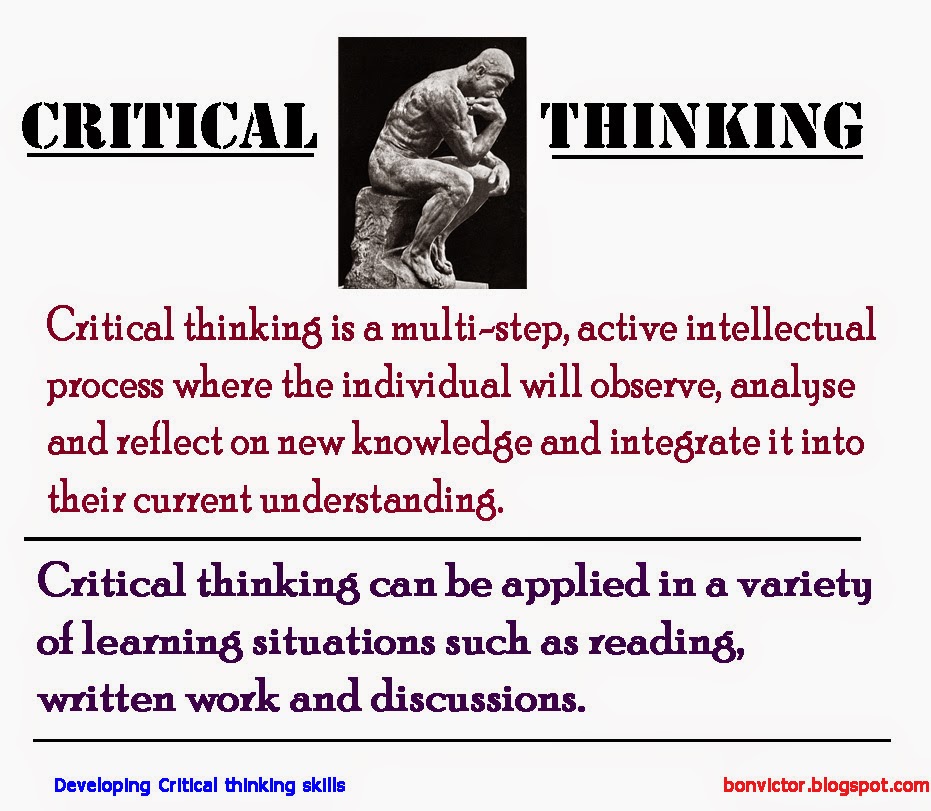
“Critical” is derived from the Greek word kritikos which means “to judge.” Critical thinking, also called evaluative thinking includes a complex combination of abilities such as ordering, classifying, and analyzing, evaluating, observing, comparing, and contrasting information for problem solving. Critical thinking involves questioning. Critical thinking is goal directed; it is the thinking with a purpose. Using logic and reasoning a critical thinker identifies the strengths and weaknesses of alternative solutions, conclusions or approaches to problems. Critical thinking has two important components: it includes a frame of mind and a number of specific mental operations.Critical thinking has three dimensions: an analytic, an evaluative and creative component. As a critical thinker, one has to analyse thinking in order to evaluate it. One has to evaluate it in order to improve it.
   Critical thinking is a process “orchestrates numerous skills and is directed toward achieving an objective."  Swartz and Perkins (1990) discuss critical thinking as “the critical examination and evaluation –actual and potential- of beliefs and courses of action.” Ralph Waldo Emerson said, "Thinking is the function. Living is the functionary."

Definitions of critical thinking

Critical thinking may be defined as "the process of purposeful, self-regulatory judgement. The process gives reasoned consideration to evidence, contexts, conceptualizations, methods and criteria (American Philosophical Association, 1990).
Critical thinking is the ability to analyse facts, generate and organize ideas, defend opinions, make comparisons, draw inferences, evaluate arguments and solve problems (Chance, 1986).
Critical thinking is reasonable, reflective thinking that is focused on deciding what to believe (Ennis 1996).
Critical thinking is skillful, reasonable thinking that is conducive to good judgement because it is sensitive to context, relies on criteria and is self-correcting (Matthew Lipman).
Critical thinking is thinking about your thinking, while you’re thinking, in order to making your thinking better (Richard Paul).
In short, critical thinking is the ability to think clearly and rationally. Critical thinking is the intellectually disciplined process of evaluating information and evaluating our thought process. In brief, critical thinking is self-directed, self-disciplined, self-monitored and self-corrective thinking.

Critical spirit

Critical thinkers need certain attitudes, dispositions, passions and traits of mind. Thinking critically requires a critical spirit or critical mindedness (Norris, 1985). The critical spirit requires one to think critically about all aspects of life, to think critically about one’s own thinking and to act on the basis of what one has considered when using critical thinking skills.Critical thinking skills enable people to evaluate, compare, analyse, critique and synthesize information.

Principles of critical thinking

Critical thinking is an active process – It involves in gathering, analyzing, synthesizing, assessing and applying data in solving problems.
Critical thinking is an organized and systematic process – It involves using criteria or standards to judge the validity of information.
Critical thinking is a search for meaning – it is a way of making sense out of the data or information.
Critical thinking is reflective – It involves thinking about your thinking.
Critical thinking involves standards – Accuracy, relevance and depth are some examples of standards or criteria.
Critical thinking is authentic – critical thinking is thinking about real problems. Real problems are often messy and unclear.
Critical thinking involves being reasonable – for thinking to be critical, it must be reasonable thinking.
Critical thinking is a skill that can be learned – It is based on active, logical reasoning on facts and evidence and a desire to learn.

Intellectual standards of critical thinking (Paul and Elder 2001).

Critical thinking includes a complex combination of skills. Critical thinkers use the intellectual tools that critical thinking offers-concepts and principles that enable them to analyse, assess and improve thinking. Critical thinkers should check their thinking according to the following standards of Paul and Elder (2001).The standards of critical thinking are clarity, accuracy, precision, relevance, depth, breadth, logic, significance and fairness. Standards are essential to increasing the quality of thinking. Increased skill in the application of standards improves the process of critical thinking.
  • Clarity- understandable, the meaning can be grasped;
  • Accuracy- free from errors or distortions, true; 
  • Precision-exact to the necessary level of detail;
  • Relevance-relating to the matter at hand;
  • Depth- containing complexities and multiple interrelationships;
  • Breadth- encompassing multiple viewpoints;
  • Logic-the parts make sense together, no contradictions;
  • Significance-focusing on the important, not trivial;
  • Fairness – justifiable, not self-serving or one sided.

3 – Parts of critical thinking

Firstly, critical thinking involves asking questions. Secondly, critical thinking involves trying to answer those questions by reasoning them out. Thirdly, critical thinking involves believing the results of our reasoning.

5 – Step process of critical thinking - IDEAS

Step 1.Identify the problem and set priorities (I)
Step 2.Deepen understanding and gather relevant information (D)
Step 3.Enumerate options and anticipate consequences (E).
Step 4.Assess situation and make a preliminary decision (A).
Step 5.Scrutinize the process and self-correct as needed (S)
The ability to think critically requires a great deal of effort and time. Critical thinking is that mode of thinking –about any subject, content or problem – in which the thinker improves the quality of his/her thinking by skilfully taking charge of the structures inherent in thinking and imposing the intellectual standards ( or a level or degree of quality) (Paul and Willsen, 1993).

A list of critical thinking skills based on Maker and Nielson ( 1996)

·         Determining fact and opinion
·         Choosing relevant from irrelevant information.
·         Determining the accuracy of a statement.
·         Determining the credibility of a source.
·         Recognizing ambiguities.
·         Identifying underlying assumptions.
·         Determining external and internal bias.
·         Recognizing valid and fallacious arguments.

5-main theoretical requirements for critical thinking (Joe Y.F.Lau 1968)

1.       Meaning analysis – Explain ideas clearly and systematically; use definitions and other tools to clarify meaning and make ideas more precise.
2.       Logic – Analyse and evaluate arguments; identify logical consequences and inconsistencies.
3.       Scientific methods – Use empirical data to test a theory; identify causes and effects; probability theory and statistics.
4.       Decision and values -Rational decision making; critical reflection of value frameworks and moral judgements.
5.       Fallacies and biases – Typical mistakes of reasoning and psychological traits likely to cause such mistakes.

Characteristics of a critical thinker (Paul R and Elder L, 2010)

1.       One who raises vital questions and problems, formulating them clearly and precisely.
2.       One who gathers and assesses relevant information, using abstract ideas to interpret it effectively.
3.       One who comes to well- reasoned conclusions and solutions, testing them against relevant criteria or standards.
4.       One who thinks open-mindedly within alternative systems of thought, recognizing and assessing, as need be, their assumptions, implications and practical consequences and
5.       One who communicates effectively with others in figuring out solutions to complex problems.

 Critical thinking and creativity

The ideas are usually composed of different elements. Our store of ideas (knowledge base) provides the ingredients to generate new ones. The new combination of ideas is formulated by joining different ideas together. In general new ideas are old ones rearranged in a new way. The ingredients for creativity depend on the store of ideas that are available for recombination.
Critical thinking is necessary to help determine the relevance and effectiveness of the idea. It is a necessary condition for cognitive creativity- the generation of new ideas and the evaluation and modification of old ideas. Creativity is enhanced by the ability to detect connections between the ideas. So if anyone wants to be creative, he /she must develop the skill of critical thinking to see the connections between different areas. Good thinking involves both critical thinking and creativity.

Benefits of critical thinking

 Critical thinking is higher-order and more complex form of thinking. It involves more evidence – based analysis of information and clear understanding of problems and solutions. Critical thinking enables faster, accurate and logical inferences and quality decisions. Critical thinking is inherent to problem solving and decision making. Good critical thinking is a cognitive skill. Using critical thinking, one is able to acquire knowledge, understanding, insights and skills in any given body of content. Critical thinkers are more flexible in their thinking and they offer a richer variety of explanations and solutions for any problem. A well cultivated critical thinker thinks open-mindedly within alternative systems of thought, recognizing and assessing their assumptions, implications and practical consequences. People, who think critically, consistently attempt to live rationally, reasonably and empathetically. Critical thinking contributes to the process of self-evaluation and transformation. They easily recognize opportunities and avoid making mistakes in problem-solving. Critical thinking results in improved planning of tasks. Critical thinking skills are essential for all sorts of careers in which we have to communicate ideas, make decisions, analyse and solve problems. Good critical thinking is the foundation of science and democracy. Science requires rationality in designing experiments and testing hypotheses. A good democracy requires citizens who can think objectively about social and political issues. The cultivation of critical thinking is central to the aim of education.
            Critical thinking uses evidence-based analysis of information.

Sunday, September 7, 2014

Effective decision making skills

Decisions are important part of our life. A decision is a choice. Life is full of choices at every moment of time. Some of the decisions are small and inconsequential, and some are large and life determining.  All decision making occurs in dynamically changing contexts. This context includes psychological aspects of the decision maker and socio-cultural aspects of the situation he or she acts in. Making good decisions is a life skill that can be learned. Each person makes decisions based on his or her knowledge, skills, values and past experiences.  Effective decision making is a matter of defining the situation, weighing the possibilities and choosing the moment to act. Peter Drucker quoted, ‘making good decisions is a crucial skill at every level.’ Decision making is a reasoning process which can be rational or irrational and can be based on explicit assumptions or tacit assumptions. Rational decisions maximize our chances of happiness, successful living and fulfillment. Anthony Robins quoted, ‘Success and failure are not overnight experiences. It’s the small decisions along the way that cause people to fail or succeed.’
Decision is a commitment to a course of action or determination of future action. Making is the process of applying the objectives in proper way. Decision making is primarily concerned with choosing between the available options. Every decision is made within a decision environment, which is defined as the collection of information, alternatives, values and preferences available at the time of decision.   Every decision making process produces a final choice. It can be an action or an opinion. Many decisions involve solving a problem. Wise decisions are decisions that are made using a definite process.  Decision making is an integral part of management, planning, organizing, controlling and motivation processes.
Decision making refers to the mental activities that take place in choosing among alternatives. Decision making is the study of identifying and choosing alternatives based on the values and preferences of the decision maker.


Effective decision making procedure

1. Identify the right decision problem – State your decision problem as goals to focus on the positive and on the future. You need to state your decision problems carefully, acknowledging their complexity and avoiding unwarranted assumptions and opinion limiting prejudices. Identification of the decision problem produces a motivational state that induces action.
2. Create imaginative alternatives to reach that goal - Your alternatives represent the different courses of action you have to choose from. It is better to ‘brainstorm’ and list the possible options. Your decision can be no better than your best alternative.
3. Understand the consequences – Consequences are the end results of each option. Consider all the facts about each alternative.
4. Choose the best alternative – You have to consider the benefits of each alternative as well as the disadvantages or cost. Your values, goals and standards will guide you in making your choice. Weigh the pros and cons and implement the best alternative. Effective implementation of the decision is critical.
5. Evaluate the decision and the process – When a problem is stated as a goal, you can use your standards to judge whether you have reached the goal or not. The decision making process is a valuable resource to help you solve problems and reach your goals. A conscious awareness of your willingness to accept risk will make your decision making smoother and more effective.


Types of decisions

Programmed decisions- are repetitive decisions that can be handled using a routine approach.
Nonprogrammed decisions- are unique decisions that generate unique responses.

Types of decision making

Intuitive decision making –is making decisions on the basis of experience, feelings and accumulated judgement.
Rational decision making – describes choices that are logical and consistent while maximizing values.
Individual decision making – is the decision taken by an individual in an organization.
Group decision making – decisions taken by a group of organizational members.
Creative decision making – The creative decision making may be characterized by the generation of a large pool of diverse and perhaps novel alternatives and a number of evaluation strategies for choosing among options. It may involve using intuition and insight before logic and analysis.

Barriers to good decision making

Hasty – making quick decisions without having much thought.
Narrow – decision making is based on very limited information.
Scattered – our thoughts in making decisions are disconnected or disorganized.
Fuzzy – sometimes, the lack of clarity on important aspects of a decision causes us to overlook certain important considerations.

Conditions in making decisions

Risk – a situation in which an individual is able to estimate the likelihood (probability) of outcomes that result from the choice of particular alternatives.
Certainty – a situation in which an individual can make an accurate decision because the outcome of every alternative choice is known.
Uncertainty – limited information prevents estimation of outcome probabilities for alternatives associated with the problem and may force an individual to relay on intuition or ‘gut feelings.’

Styles of making decisions

Reflexive style – Such people makes quick decisions without taking the time to get all the information that may be needed and without considering all the alternatives.
Reflective style – Such people takes plenty of time to make decisions, gathering considerable information and analysing several alternatives.
Consistent style – Such people tends to make decisions without either rushing or wasting time.
Linear thinking style – a person’s preference for using external data and facts and processing this information through rational, logical thinking.
Non-linear thinking style – a person’s preference for internal resources of information and processing this information with internal insights, feelings and hunches.

Guidelines for effective decision making

1. The decision problem should be defined properly.
2. More quantity of reliable information is gathered for effective decision making.
3. Various views at the same point are taken into account for quality decisions.
4. Decision should be made at proper time to meet the competitive advantages.
5. More alternatives can be generated by brain storming
6. Decisions can also be made on the basis of questionnaire filled by respondents (Delphi technique).
7. Decisions can be made on the basis of majority opinion (consensus).

Benefits of effective decision making

1.       It focuses on what is important
2.       It is logical and consistent
3.       It is straightforward, reliable, easy to use and flexible.
4.       It acknowledges both subjective and objective thinking and blends analytical with intuitive thinking.
5.       It requires only as much information and analysis as is necessary to resolve a particular dilemma.
6.       It encourages and guides the gathering of relevant information and informed opinion.

Errors in decision making

Over confidence – when a decision maker thinks he knows more than he do or holds unrealistic positive views of himself.
Immediate gratification – decision makers tend to want immediate reward and to avoid immediate costs.
Anchoring – decision makers fixate on initial information as a starting point and then once set, fail to adequately adjust for subsequent information.
Selective perception – decision makers selectively organize and interpret events based on their biased perceptions.
Confirmation – decision makers seek out information that reaffirm their past choices and discount information that contradicts past judgement.
Framing – decision makers select and highlight certain aspects of a situation while excluding others.
Availability – decision makers tend to remember events that are the most recent and vivid in their memory.
Representation – decision makers assess the likelihood of an event based on how closely it resembles other events.
Randomness – decision makers try to create meaning out of random events.
Sunk costs – decision makers forget that current choices can’t correct the past.
Self-serving – decision makers who are quick to take credit for their successes and blame failure on outside factors.
Hind sight – decision makers tend to falsely believe that they would have accurately predicted the outcome of an event that outcome is actually known.

Systematic decision making (Simon, a Nobel laureate,SIM 77)

It involves 3 major phases 1) Intelligence or information gathering phase 2)Design phase 3)Choice phase followed by the implementation phase. Decision making phase starts with the intelligence phase where reality is examined and the problem is identified. In the design phase, a model that represents the system is constructed. The choice phase includes selection of a proposed solution to a model. Once the proposed solution seems to be reasonable, it is ready for the implementation.

Significance of good decisions in business world
Good decision making is as important in the working world as it is in the rest of our lives. Every day a number of decisions must be made that determine the direction and efficiency of the organization we work for. Decisions are made concerning production, marketing and personnel. Decisions are made affecting costs, sales and margins. Just as in our personal lives, the key to organizational success is to make good choices. The organization must have effective decision making (ref: Delivering business intelligence with Microsoft SQL server 2008).
                    Decisions determine the direction and efficiency.

“In the long run, we shape our lives, and we shape ourselves. The process never ends until we die. And choices we make are ultimately our own responsibility.” - Eleanor Roosevelt.

Wednesday, September 3, 2014

Creative problem solving skills

Solving problems is a complex mental process that characterizes one of the most intelligent human activities. Problem – solving is a tool, a skill and a process. As a tool it helps anyone to solve a problem or achieve a goal. As a skill one can use it repeatedly throughout his/ her life.  As a process, it involves a number of steps. In fact we experience problems on a daily basis. Major problems can have a negative impact on our overall quality of life. The problem solving is either an individual or collaborative process composed of two different mental skills: (1) to analyse a situation accurately (analytical) and (2) to make a good decision based on that analysis (creative).  Analytical thinking includes skills such as ordering, comparing, contrasting, evaluating and selecting. It helps to identify the real cause from many possible causes (convergent process). Creative thinking is a divergent process using imagination to create a large range of ideas for solutions. The object of problem solving is usually a solution, answer or conclusion. Solving a complex problem requires more than mere knowledge; it requires the motivation and personal resourcefulness to undertake the challenge and persistence until a solution is reached.


Definition of a problem

The concise Oxford Dictionary (1995) defines problem as ‘A doubtful or difficult matter requiring a solution’ and ‘something hard to understand or accomplish or deal with.’  
A problem exists when a person wants something and does not know how to get it. The problems can be specific or general, positive or negative and major or minor in importance or scope.

Definition of problem solving

Problem solving is the process of working through details of a problem to reach a solution. The US Dictionary defines problem solving as the process of finding solutions to difficult or complex issues. In other words problem solving is ‘thinking that is directed toward the solving of a specific problem that involves both the formation of responses and the selection among possible responses.’

Guiding principles of problem solving

Problems are natural – People must understand that problems are natural part of life. Buccchianeri E.A quoted, “Well if it can be thought, it can be done, a problem can be overcome.”
All life is problem solving- Problem solving is an ongoing, perpetual thing. Joey Lawsin quoted, “The opposite of a problem would likely be the correct solution.”
Problems are solvable – people can do something about the problem. John Dewey quoted, “A problem well put is half solved.” Robert H. Schuller quoted, “Problems are not stop signs, they are guidelines.”
Problems are opportunities to make some good things happen. Author Brian Adams quoted, “Difficulties are opportunities to better things; they are stepping stones to greater experience...When one door closes, another always opens; as a natural it has to balance.”
Problems are challenges – they call upon the best of our abilities and ask us to go beyond what we thought we could do. Gever Tulley quoted, “Persistence and resilience only come from having been given the chance to work through difficult problems.”


Problem solving phases

1. Input phase – a problem is perceived and an attempt is made to understand the situation or problem. Problem solver gathers information or facts relevant to solving the problem;
2. Processing phase – alternatives are generated and evaluated and a solution is selected;
3. Output phase – includes planning for and implementing the solution;
4. Review phase – solution is evaluated and modifications are made, if necessary.

Problem solving procedure

1. Problem recognition – It involves detecting and recognizing that there is a problem exists and identifying the nature of the problem. Identifying a problem requires more thought and analysis. The identification of personal cues such as thoughts, feelings and behaviours provides the information for the existence of a problem which can be used in the subsequent steps of the problem solving process. This stage is all about gaining more information about the problem and increasing the understanding.
2. Problem definition – It is the process of defining the problem in a solvable form. A well defined problem will accurately describe the problem situation (context). As Edward Hodnitt stated, “A good problem statement often includes a) what is known b) what is unknown and c) what is sought.”
3. Generation of alternative solutions – It is now time to start thinking about possible solutions to the identified problem. One effective strategy for generating alternative solutions is brain storming.
4. Evaluation of alternative solutions – Once all the alternatives have been generated, it is time to evaluate the potential effectiveness of each of them in solving the problem.
5. Making a decision – This is perhaps the most complex part of the problem solving process. This stage involves careful analysis of the different possible courses of action and then selecting a solution which has the greater potential for effectiveness.
6. Implementation of the solution – Once the solution has been identified, it is time to implement one or more of the chosen solutions.
7. Verification of the solution’s effect – It is essential for a problem solver to verify the whether or not the solution was executed according to plan and then evaluated to determine its effectiveness.

7-Step problem solving procedure (Finkelman 2001)

The first step is defining the problem by clarifying the task and describing it in a single sentence. The second step is gathering information from a variety of sources and analysing the data. The third step is determining the overall goal or desired outcome to guide decision making and actions toward the desired outcome. The fourth step is developing potential solutions to make the best choice. The fifth step is considering the consequences for each of the identified potential solutions. Making the best decision is the sixth step. Finally implementing the solution, evaluating its effectiveness and taking necessary corrective action occurs.

9 – Step problem solving procedure (Dailey 1990)

1. Identifying problems
2. Determining perceptions
3. Determining the underlying causes of problems
4. Assessing the magnitude of the problem
5. Constructing a plan
6. Implementing a plan
7. Test-piloting the plan
8. Tracking effectiveness
9. Publicizing results.

Creative problem solving (CPS) Treffinger’s Model

The problem solving process of the CPS model (Donald and Treffinger, 2000,Isaksen and Treffinger, 2004) consists of a total of six steps
1. Objective finding – helps to identify problem ‘messes’ by using divergent thinking and then converge to select a broader goal.
2. Fact finding –focuses on examining many facts or data about the situation to form the basis for the next step.
3. Problem finding –helps generate many possible restatements of the problem.
4. Idea finding – helps generate promising ideas and possible solutions for the problem.
5. Solution finding – develops criteria to evaluate those ideas and solutions.
6. Acceptance finding – helps generate ideas for facilitating implementation of the most promising alternatives and building these ideas into a plan of action.
Brain storming is an essential component of each step. Each step involves divergent thinking to generate ideas and possibilities and convergent thinking to select insightful elements, synthesis or refine. The CPS model emphasizes harmony and balance between divergent or creative and convergent or critical thinking.

Aspects of problem solving

Being flexible – you have to be flexible and willing to try something different;
Take time to think – you should brainstorm a little about the different ways you can solve the problems;
Ask questions – part of solving a problem is to create new questions to answer;
Look at the problem in a different way – try thinking differently about the problem. Avoid your natural tendencies. Remember perspective is everything in solving a problem;
Think unconventionally – come up with solutions that make no or little sense. You might surprise yourself and actually run across an unconventional idea that is the perfect solution to your problem.

Problem solving strategies

Direct intervention – involves you personally doing  a task or activity.
Indirect intervention – requires good interpersonal skills such as negotiation, conflict resolution, persuasion and confrontations to influence others to carry out activities or resolve the problem.
Delegation – is used to assign the responsibility of an activity or task to another for the purpose of workload distribution.
Purposeful inaction – is consciously ignoring or choosing not to make a choice with the hope that the problem may go away with time.
Consultation or collaboration – is exchanging information with peers or colleagues to solve a problem.

Problem solving tools

Abstraction – solving the problem in model of the system before applying it to the real system.
Analogy – using a solution that solved an analogous problem.
Brain storming – suggesting a large number of solutions to a problem and then combining or developing them to find out an optimum solution.
Fractionalization – breaking down a large complex problem into a smaller, solvable problem.
Hypothesis testing – assuming a possible explanation to a problem and trying to prove/disprove assumptions.
Lateral thinking – approaching solutions indirectly and creatively.
Means-ends analysis – choosing an action at each step to move closer to the goal.
Morphological analysis – assessing the output and interactions of an entire system.
Reduction – transforming the problem into another problem for which solutions exist.
Research –employing existing ideas or adapting existing solutions to similar problems.
Root-cause analysis – eliminating the cause of the problem.
Trial -and – error –testing possible solutions until the right one is found.
Proof – try to prove that the problem cannot be solved. The point where the proof fails will be the starting point for solving it.

Benefits of problem solving

Effective problem solving has been found to be associated with optimism, hope, greater self-esteem and self-confidence, improved health and emotional well being and a strong sense of overall satisfaction in life. Effective problem solvers view problems more as opportunities for growth or positive change rather than threats. Solving problems provide necessary skills to handle new problems. They also have self-confidence in their ability to adequately tackle difficulties and attempt to react to problems in a thoughtful, planful and systematic manner. Problem solving decreases one’s impulsivity and social withdrawal. Effective problem solving skills serve to increase the likelihood that such individuals can adapt more successfully to life’s strains and difficulties.
                        ‘To every problem, there is a solution’

Saturday, August 30, 2014

Therapeutic nutrition

Diet plays a major role in curing diseases or restoring the health by supplying the needed nutrients. Diets are composed of nutrients: macronutrients (proteins, fats and carbohydrates) and the micronutrients (vitamins, minerals and trace elements). Special dietary measures may be required to maintain lives of patients, who have chronic heart, kidney, liver and gastrointestinal diseases. These diets must also consider and supplement the effects of medications on nutrients. The regular diet is a normal unrestricted diet and is the food a person eats every day. The regular diet is well balanced and has a variety of foods from the food pyramid. A therapeutic diet is usually a modification of a regular diet. Therapeutic diet is formulated to optimize the nutritional needs of a particular patient. Therapeutic diet differs from a regular diet in the amount of one or more nutrients or food components for the purpose of treating or healing a disease or illness. The therapeutic diet is also called ‘special diet’ or ‘modified diet.’ A therapeutic diet is made under a physician’s guidance.
Therapeutic diet have modified for nutrients, calorific contribution, texture or consistency and /or food allergies or food intolerances.  For example, a cardiac diet is low in fat or cholesterol. A diabetic diet is low in sugar and fat. A clear liquid diet may be used to maintain hydration during gastro-intestinal illness such as nausea, vomiting and diarrhoea. Calorie – controlled diet is served to residents who are overweight. Sodium – restricted diet is served to residents with heart or kidney disease. High fiber diets (30g or more) are believed to help prevent diverticulosis, constipation, haemorrhoids and colon cancer.


Definition of diet therapy

Diet therapy is the use of any diet for restoring or maintaining optimal nutritional status and body homeostasis. The purpose of diet therapy is to restore or maintain an acceptable nutritional status of a patient.

Therapeutic nutrition

Therapeutic nutrition is broadly defined as the use of nutrients such as vitamins, minerals, amino acids, essential fatty acids, co-factors, enzymes, antioxidants and phytonutrients to support the body’s immune and healing systems, thereby altering the course and outcome of a disease process. It can be used as a preventive or can be used as a therapy. The goals of therapeutic nutrition include the supply of appropriate, bioavailable nutrients, the reduction of inflammation and the enhancement of elimination of toxins. Therapeutic nutrition is concerned with the treatment of patients by prescribing the right type of diets in order to meet their nutritional requirements.

The role of therapeutic diet

1.       To correct dietary deficiencies
2.       To maintain the patient in good nutrition state
3.       To formulate diet to meet the need of the patient.
4.       To educate the patient and family.

Types of therapeutic diets

Simplest therapeutic diets – are mechanically altered diets.  Mechanically altered diets contain foods that are pureed, chopped/ ground or soft for patients who have difficulty in chewing or swallowing. Mechanical soft diet is produced by simply grounding or chopping the food so it requires minimum chewing. For a pureed diet, the regular food is pulverized to a pureed consistency using a food processor.
Liquid diets – the diet is liquid at body temperature. Liquid diets may clear liquid or full liquid. The diet includes fruit juices, water gruels (strained and liquefied cooked cereals). This diet may be used after surgery. This diet can replace fluid lost from vomiting or diarrhea.
Soft or bland diet – it consists of easily digested foods that do not irritate digestive tract.
Restricted residue diet or low residue diet – it eliminates or limits foods that are high in bulk or fibre. It is used for patients with digestive and rectal diseases.
Hippocrates diet – is a natural diet of unprocessed and unchanged food as it is found in nature. It consists of fruits, vegetables and greens; fresh fruit and chlorophyll juices, sprouted seeds, grains and legumes; nuts and seeds; fermented foods and small amounts of raw honey.
Palaeolithic diet – it is also called caveman diet or stone age diet or hunter- gatherer diet. It is basically a high protein, high fibre eating plan. The diet includes a lot fresh lean meats and fish and vegetables and healthier fats.
Vegetarian or  neutral  diet – the vegetarian diet is sourced from plant products, plus dairy products and egg.The neutral diet is diet that contains the least amount of contaminants, pollutants or allergens. A vegetarian diet is the healthiest diet. A vegetarian diet reduces the risk for obesity, coronary artery disease, high blood pressure, diabetes and certain types of cancers. A diet rich in animal fats is the least healthy.
Vegan diet – consists of fruits, vegetables, legumes, grains, nuts and seeds. No eggs, cheese, yogurt, ice cream, butter or other milk products are eaten.
Raw food diet – consists 70% of raw fruits and vegetables and 30% of grains, nuts, dairy products and meat. Eating fresh, organic raw fruits and vegetables will increase the vitamins and micronutrients in your diet.  The raw foods have high levels of antioxidants with health promoting and disease preventing compounds.
Gluten free diet – Gluten is a protein found in wheat, rye, barley, triticale and oats. People with celiac disease (a digestive disorder) are sensitive to the presence of gluten in the diet. Gluten free foods include meat products, fish, dairy products, fruits and vegetables, pasta and noodles, rice and potatoes.
Calcium rich diet – calcium is absolutely critical nutrient in regulating acid/alkaline balance in the blood. Calcium plays another critical role in maintaining structural integrity of our skeleton. Excess calcium can deposit in blood vessels and kidneys. The diet includes dairy foods, sardines, collards, greens, spinach, sesame seeds and scallops.
Iron rich diet – Iron is an essential nutrient required for the synthesis of haemoglobin which carries oxygen in the blood. Iron deficiency anaemia is a worldwide health problem in young women and in children. Iron rich diet consists of broccoli, soybeans, bok choy, lentils, dark green vegetables, meat, poultry and fish.
Protein restricted diet – The average person needs between 40 to 65 grams of protein each day. People with chronic liver or kidney disease should limit protein intake. Proteins contain 16% nitrogen, which the body eliminates in the urine as urea. In cases where liver or kidney function is impaired, urea, ammonia or other toxic nitrogen metabolites may build up in the blood. To control protein intake, foods such as starches, sugars, grains, fruits, vegetables, fats and oils should be eaten at levels sufficient to meet daily energy needs. The purpose of a low protein diet is to prevent worsening of kidney or liver disease.
Mediterranean diet – consists of food mainly plant sources such as vegetables, fruits, cereals, legumes, garlic, nuts, olive oil, moderate amounts of fish, chicken, yogurt, red wine; low in cheese, eggs, saturated fats, sugar and red meat. A study has reported that this diet lowers the incidence of secondary heart attacks by 70% - a 70% reduction in deaths from all causes.
Detoxification diet – a diet of fruits, raw vegetables, water and yogurt to eliminate toxins absorbed from the environment or caused by poor digestion or poor excretion waste products.
The Atkins diet – It is a high-protein, low carbohydrate diet developed by Robert Atkins during 1960s. It is the most famous weight loss diet. It is based on the simple premise of a diet high in sugar and refined carbohydrates causes weight gain and ultimately leads to obesity. There are four phases to the Atkins diet: induction phase, ongoing weight loss, pre- maintenance and lifetime maintenance phase.
The macrobiotic diet – was developed in the 1920s by George Ohsawa. It consists of a simple diet of brown rice, miso soup and sea vegetables. Whole grains such as brown rice, barley, millet, oats, corn and rye makeup the bulk of the macrobiotic diet. This diet encourages the consumption of vegetables such as cabbage, broccoli, cauliflower, kale, bok choy, collards and mustard greens. Beans, tofu and sea vegetables should be eaten on a daily basis.
Zone diet – was developed by Barry Sears. The zone diet proposes a dietary ratio of 40% carbohydrate, 30% protein and 30% fat.

Benefits of therapeutic diets

It is essential or life saving treatment in the case of coeliac disease, phenylketonuria and galactosemia. Therapeutic diets are used to replenish patients who are malnourished in the case of cancer or intestinal diseases. Therapeutic diets are used to produce a negative nitrogen balance in obese people. Therapeutic diets are used as an alternative or complementary treatment in the case of diabetes or hypertension. Therapeutic diets are used to provide standard condition for diagnostic tests in the diagnosis of food sensitivity.
     Diet therapy restores or maintains an optimal nutritional status of a patient.