Showing posts with label Life Skills. Show all posts

Thursday, June 16, 2016

Worldviews: the best way to change your lens on the world

People have different mental concepts and different ways of looking at the world. A worldview is a person’s mental concept on all of the world and the whole of life or a system of philosophy relating to it. Worldview literally means “a general view of the world” or “philosophy of life.” Every human being has a worldview. Most people do not even know they have one. A worldview can be true about some things and not true about other things. Worldview is the framework of beliefs, values and images within which a person makes decisions and conducts the business of living. In other words our worldview not only describes reality, but it also prescribes how we act and respond to every aspect of life. The worldview is not only the content, but also the mode of thinking about reality. Worldviews develop over the course of a lifetime and are transmitted from generation to generation through such means as education, family tradition, religious belief, political orientation and the mass media. Worldview affects what one believe about God, marriage, politics, social structures, environmental concern, educational requirements, economics, the raising of children, food habits etc.
Scope of worldviews
Our worldviews help in determining our priorities in life. Worldviews helps to explain our relationship to God, fellow human beings and environment. Worldviews help oneself to assess the meaning of events. Worldviews also helps to justify one’s actions.
“The ideas and beliefs we use to guide our actions. We use them to explain cause and effect as we see them, and to give meaning to our experience.”  -O’Connor, 1997.
Definition
The term ‘worldview’ is a mental framework through which individuals and groups view the nature of reality, the nature and purpose of human life, and the laws governing human relationships.
“A worldview constitutes an overall perspective on life that sums up what we know about the world, how we evaluate it emotionally, and how we respond to it volitionally” (Rudolf A. Makkreel 1999).
Phillips and Brown (1991) state that, “a worldview is, first of all, an explanation and interpretation of the world” and second, “an application of this view to life.”
The term ‘worldview’ or weltanschauung (German) was first used by Immanuel Kant in his Critique of judgement, first published in 1970. He combined two German words into one: welt which means “world” and Anschauung, which means, ‘conception’ ‘idea’, opinion’ or ‘view’.
Salient features of worldview
The worldview is the overall perspective from which one sees and interprets the world. Most worldviews are learned early in life and are not easily changed. Worldview is intuitively developed and does not require individuals to have higher or university education. Worldview is not one’s point of view but it is much more than personal preference or opinion. Worldviews evolve in response to critical examination and reflection. Every religion reflects a worldview and every secular ideology reflects a worldview. Worldviews are often varying among individuals as a result of cultural traditions and experiences. Worldviews are ideal types. They are used for description rather than prescription; for analysis rather than evaluation.  The worldviews are shaped by our life experiences which in turn reshape our approach to life. Religion, philosophy, ethics, morality, science, politics and all other belief systems shape our worldview.  Worldviews can be resources for understanding and analysing conflicts when fundamental differences divide groups of people. Worldviews are important determinants of risk perception. Worldviews shape all that we think, do or consider to be normal or abnormal and acceptable or unacceptable and trustworthy or unreliable. Worldviews can lead to beliefs, behaviour and lifestyles that can work for or against environmental sustainability. The analysis of one’s worldviews is a powerful starting point for examining belief systems.
Characteristics of worldviews
  1. Worldview is the truth claims that explain the world and reality. It is the sum total of what we believe about the world. It helps people make sense of the world.
  2.  Worldview should be rational. It should not be contradictory.
  3.   It should be supported by evidence. It should be consistent with what we observe.
  4.   It should give a satisfying comprehensive explanation of reality.
  5.   It should provide a satisfying basis for living.
Types of worldviews
Formal worldview –is a major system of ideas that orders human hearts and mind.
Personal worldview – is one-to-one relationship with the established formal worldviews.
Environmental worldview – is collective beliefs and values that give people a sense of how the world works, their role in the environment and right or wrong behavior toward the environment.
Western worldview –sees human as dominant over nature and feels natural resources should be used for the benefit of humanity.
Key elements of worldviews
Views of human nature- basic beliefs about nature of people-e.g. people are naturally good or evil.
View of the good life – the goals to strive for living one’s life – e.g. personal accomplishment, peace of mind, love, adventure.
Equality with others – belief about the status of some individuals or groups in relation to others – e.g. social status and hierarchy.
Responsibilities to others – beliefs about the extent of obligations to others – e.g. self-centered or other- centered.
Relationship between individual and the state (govt) – beliefs about the balance between individual and collective rights – e.g. individual rights are more important than the rights of the society.
Relationship of humans with nature – beliefs about the way human beings should look on and act toward the environment – e.g. preserving nature is more important than using natural resources to support human activity.
Sources of ethical wisdom – beliefs about the ultimate authority for ethical principles – e.g. religion, God, science, natural rights.
Core areas of worldviews 
  1. God and the immaterial
  2. The meaning and purpose of life
  3.  Human nature
  4.  What we trust in the primary source of spiritual truth.
Factors affecting worldviews
Ideas and knowledge – what a group knows e.g. scientific, intellectual, technological, artistic and spiritual knowledge.
Contact with other groups – interactions between societies and between different groups in a society.
Geography – where a group lives: the climate, plants and animals, bodies of water and natural resources.

Importance of worldviews
Worldviews serve as the necessary foundation and framework of our thoughts and actions. It is our belief about what is real and important –belief about the unseen –the spiritual, the philosophical and valuable. Our worldview will determine how we interpret our lives and the world around us. It shapes how we think about everything. Everyone constructs ‘a worldview story’ to make sense of our lives. Different cultural contexts lead to the formation of unique worldviews, beliefs, values, and assumptions, modes of social conduct, behavior and expectations among individuals.  Worldviews keep our lives coherent, giving oneself a sense of meaning, purpose and connection. Worldviews create a context for everything we do. Worldviews provide some purpose to a given cultural system. It gives a paradigm of reality for a particular society. Worldviews stimulate people’s imagination.  Worldviews have formative influence on the lives of individuals, communities, groups and especially those in positions of leadership. Worldviews have a significant influence on the overall health of an individual. Worldviews can influence student learning and development in academic settings. Worldviews contain something more than scientific information. Region is the cornerstone of worldviews.
“Our worldview changes as our beliefs change. If you change your core beliefs in your worldviews,then your life will change drastically.”

Monday, June 13, 2016

Personal creativity- the unique human resource

What is creativity?
Creativity is defined as a combination of abilities, skills, motivations and attitudes (Honig 2006). In other words, creativity is the capacity or ability of an individual to create, discover or produce a product, thought, art, process etc.  Creative thinking is thinking ‘out of the box’ to produce new, novel or original unique ideas or solutions. The creative process uses divergent and convergent thinking. Facione (1998) describes creative or innovative thinking as the kind of thinking that leads to new insights, novel approaches, fresh perspectives, and whole new ways of understanding and conceiving things.
Creativity is complex
Creativity is a highly complex phenomenon.  The creative process refers to the sequence of thoughts and actions that leads to a creative idea or a product. Creativity involves ideas, purposefulness, playfulness, exploration, problem solving, and artistic and imaginative invention. Creativity requires the interaction of four themes – people, context, method and outcome. In short, creativity is not a simple thing- it is multidimensional.
Every human is a creator
Every person is inherently creative.  Expression of creativity in each person is only a matter of degree and frequency. Creativity is possible in all areas of human activity like arts, sciences, business, technology and daily life. Creativity has transformed our cultures, economies and life styles. Creativity is valued by human society.  Creativity is a major driver of human evolution.
Creativity is a habit (Sternberg 2006)
An eminent American psychologist Robert J. Sternberg conceived of Creativity as a habit  – a routine response. Creative people habitually respond to problems in fresh and novel ways (Albert and Runco 1999). Creativity can be made into a habit. There are three basic factors that help turn creative thinking into a habit: opportunities (to engage in it), encouragement (to go after such opportunities) and rewards (for the demonstration of creative outcomes).
Creativity exists at all ages
The potential for creativity exists in all people and at all ages. In general creativity develops with age and experience. Creativity may changes in quality across the life span. Creativity is a function of knowledge, curiosity, imagination and evaluation. Creativity is bound to situations and contexts. Creativity is a state of mind that is fresh, alert and sensitive.Creative mind explores new possibilities, patterns and options. Creative individuals are typically “buy low and sell high” in the world of ideas (Sternberg and Lubart 1995).
Creativity exists in all domains
Creativity is found in many domains such as the arts, literature, sciences and everyday life. Creativity is often enhanced when one crosses domains. Creative people often transfer their knowledge and skills from one field and apply them to another. They have the advantage of seeing the new domain from different perspectives and of making significant changes. Creative people are really good at mixing and matching all sorts of seemingly contradictory emotions, ideas and personality traits to produce something truly original and valuable.
Creativity is making and breaking connections
Making is connecting –making connections is an important aspect of creativity (Duffy 1998). The acts of creativity usually involve connecting things together (materials, ideas or both) to make something new and novel.  Creativity arises from the conceptual integration of other’s ideas. Conceptual blending is a creative thinking process that involves blending two or more concepts in the same mental space to form new ideas.  Creativity is the ability to make connections between things that do not seem related. Sometimes creative ideas may come from new combinations of old ideas.
Creativity keys
The first key to creative thinking is clarity. Creativity needs critical thinking in evaluating and improving ideas. Critical thinker thinks clearly, precisely and rationally. The second key is concentration.  The creative thinker has to put aside and concentrate single-mindedly on focusing one’s mental powers on solving one single problem. The third key is open mind. The creative thinker tends to remain very flexible and open to a variety of ways of approaching the problem. The fourth key is inspiration. It means being inspired by oneself or by others. Creativity thrives on curiosity, fresh input and rich domains of knowledge. Another key to creativity is motivation i.e., having a purpose to do so. Motivation is what we need to add value to creative effort. Creativity needs encouragement of others. The sixth key to creativity is gestation i.e. allowing time for creative ideas to emerge. Insight and intuition are often associated with creativity. The seventh key to creativity is collaboration through the support of others or a community.
Creativity is the main driver of innovation
Creativity is about imagination and ideas whereas innovation is about actions and process. Creativity is largely cognitive and innovation is largely behavioural. Creativity involves only ‘thinking up new things’ and innovation is only ‘doing new things’ (Peters and Waterman 1982). Innovation is the end result of creative process. The ideas (creativity) can be capable of being transformed into successful action (innovation).  Innovation requires creativity, but creativity does not always lead to innovation.
        Creative power = Imagination+ Determination+ desire to launch
Creativity is a synergy of many personality traits
There are six personal traits essential for creativity: intelligence, knowledge, thinking styles, personality attributes, motivation and environment. Creative people possess a cluster of traits such as curiosity, originality, ingenuity and a willingness to challenge convention and tradition. Creative people are purposeful dreamers. Day dreaming is a healthful, problem solving brain practice. Dreamers always dream of change. They dream of better world, a better reality and a better future.
A creative person is a divergent thinker
Divergent thinking is a prerequisite for creative performance. Divergent thinking is one aspect of lateral thinking. Fluency, flexibility and originality are considered the primary components of divergent thinking. Divergent thinking involves processes like shifting perspectives, transforming or producing multiple answers from the available information and thus favours the production of novel and unconventional ideas.
Creativity is a  process
Creativity unfolds as a process. In 1926, Graham Wallas described stages of creativity in which a creative idea is first prepared, then internalized through incubation, after which the creative individual uses the illumination or insight to finally go through the verification process of applying the idea.
             Preparation à Incubationà Illumination à Verification (Wallas, 1926).
            Clarificationà Transformation àImplementation
Diversity is the mother of creativity
Cultural diversity breeds creativity. Culturally different people have different interpretations of the world. People have different ways of generating solutions to problems. Diversity in thinking looks for solutions from diverse perspectives of a problem. Teams can use diversity of techniques in order to generate more creative ideas. For example teams with racial diversity significantly outperform the groups with no racial diversity.
Creativity is tied to culture
Culture is what makes us who we are. It gives us strength; it is a wellspring of creativity and innovation.  There are many different ways by which societies shape all aspects of creative expression ranging from the availability of resources to the provision of rewards.
Creativity is enjoyable
Creativity brings about a sense of satisfaction, accomplishment and reward. It can also provide a sense of peacefulness and joy. There is a direct connection between fun and laughter and creativity. Freedom, democracy and tolerance encourage greater creativity.
Creativity shapes academic success
Educational achievement is closely associated with creativity and intelligence to a certain level. Creativity is more important than intellectual capacity- helping one to learn more effectively, efficiently and flexibly. In general creative individuals are achievement – oriented.
Creativity is valuable
The outcomes of creativity bring about benefits for individuals, groups and organizations. A nation needs creative scientists, engineers, technocrats economists, poets, painters, musicians etc. . Great inventions, scientific discoveries, all forms of artistic expressions –painting, literature, music, drama – have depended on creative thinking. Creativity is the central ingredient in human development. The function of creativity is to improve society, products and services become more convenient, cheaper, faster and better. Creativity transformed our cultures, our lifestyles and our daily life. Creativity is an essential skill for effective leadership and entrepreneurship. Creativity is critical to the performance and survival of any organization. Creativity is an ultimate economic resource. Historians of sciences have used “discoveries” as the bench marks of economic progress.
Creativity is a tool for survival
Creativity is one of the primary instincts and motivating forces of life. Everyone is born creative. Creativity is a natural part of being human. Creativity provides anyone with an intrinsic ability to face and respond to the uncertainty and mysteries of our existence. Creativity supports one’s drive to be more competitive, productive and effective. Creativity is a vital source for meeting the challenges and dangers as well as opportunities.
Creativity is 85% a leaned skill (Harvard study) 
Creativity is potentially achievable by anyone, anywhere. Everyone can strengthen their creative powers with practice, persistence and patience. In order to develop creativity, one has to focus on creativity every day. He has to try something new every day. Creativity is more like a muscle that needs to be exercised in order to consistently give out best results.
“Creativity stands out as an activity to be studied, cherished and cultivated.”  -Silvano Arieti.

Thursday, February 19, 2015

Principles of effective leadership

Leadership is one of the most complex human behaviours. Leadership is a multidimensional process that is conceptualized as a trait, as an ability, as a skill, as behaviour, as a relationship and as a process (Northouse 2015, author: Introduction to Leadership). Effective leadership is a key factor in the survival and success of an organization. Leaders can make the difference between success and failure. A leader is a person who directs, organizes, administers, makes decisions, delegates possibilities and plans for future. Effective leadership needs skills, styles, character and the spirit of serving to be effective, efficient and productive. Leaders need to have a vision, communicate that vision with passion so followers are inspired. Successful leaders have a strong desire to lead and exercise power, exhibit honesty and integrity and are highly self-confident. The world’s most effective leaders –Gandhi, Mandela, Churchill, Lincoln, Thatcher, Mother Teresa etc. – display widely different personal qualities.

Leadership concept

Leadership can occur between the leader and another individual; between the leader and a group, or an organization or a community or a society. Leaders need followers in order to lead. Followers need leaders in order to follow. Leadership is a relational concept. Leadership exists in relation to others (followers). Leadership deals with people in relationships. Jim Kouzes and Barry Posner said, ‘Leadership is a relationship between those who aspire to lead and those who choose to follow.’ So leadership is composed of leaders, followers as well as situations. Leadership is a process of social influence (not power), which maximizes the efforts of others, towards the achievement of a goal (Kruse 2013). Psychologist Bernard Bass (1990) reviewed 28 studies and found evidence that the desire for achievement is an important motivating factor among effective leaders.  Successful leaders are characterized as “electric, vigorous, active and full of life.” (Kouzes and Posner 1987). They are ‘tirelessly persistent’ in their activities – especially in communicating their vision to followers (Bass 1990).

Leadership definition

Leadership is commonly defined as a process of interaction in which the leader influences others toward goal achievement (Yukl 1998). Leadership occurs among people, involves the use of influence and is used to attain goals.  So leadership can also be defined as the ability to influence people towards the attainment of goals. Leadership is a ‘people activity.’ In order to lead, the leader must do something benefiting followers and the followers allow the leader to lead. Leadership is a transaction between leaders and followers.  Leadership is a process whereby an individual (a leader) influences a group of people to achieve a common goal.

Leadership factors

Leadership is composed of four primary factors such as leaders, followers, communication and situation.
Leader –leaders require traits, skills and knowledge. The leadership traits include intelligence, self-confidence, determination, integrity and sociability (Stodgill 1974).
Follower – The process of leadership involves the leader and the followers in interaction. Peter Drucker said, “The only definition of a leader is someone who has followers.”
Communication- Communication skills are the foundation for effective leadership.  Communication includes how the leader speaks, listens and learns. Many American presidents like John F Kennedy, Franklin D Roosevelt and Abraham Lincoln have made impact as great communicators.
Situation – the situation normally has a greater effect on a leader’s action than his/her traits. What a leader do in one situation will not always work in another.

Leadership theories

Trait theory – assumes that a leader is born with specific traits that made him/her a good leader. This theory assumes that the leader is different from the average person in terms of capacities, talents and personality.
Behavioural theory - assumes that anyone can learn to become a good leader because he is not drawing on personality traits.
Transformational theory – assumes that people will follow a leader who inspires and motivates them.
Transactional theory – assumes that people are motivated strictly by reward and punishment.

Leadership function

Leadership have three essential roles: they have to define the task, achieve the task and maintain effective relationships.
Planning – seeking all available information and defining the task; developing a workable plan.
Initiating – explaining people the aims and the plan;
Informing – clarifying the task and the plan; summarizing suggestions and ideas coherently;
Controlling – making sure that all resources and energies are properly harnessed;
Supporting –setting and maintaining organizational and team values and standards;
Motivating – gaining the goodwill and genuine commitment of the team and each member;
Evaluating –establishing and applying the success criteria appropriate to the field;
Setting an example – leading from the front while exemplifying the qualities and behaviours expected in the team.

 Leadership components

Character – the leader’s behaviour and personality;
Style –the way leader relates and does the job daily;
Skills – performance, which could be developed on the job;
Service – a leader is a servant first and then a boss. Leadership is relationship of service to people and purpose (Kouzes and Posner)

Leadership characteristics

The purpose of leadership is to change lives. The leader bears an almost sacred duty to create conditions that enable people to grow and have happy and productive lives (Senge 1990). Leadership is often thought of as more inspirational or guidance –oriented as well as informal. Leadership relies more on personality traits and people skills. Leadership is thinking creatively and innovatively; empowering others through focus on execution. A leader who is innovative and produces better results is respected and looked upon. In a research conducted in 2008 (McKinsey research), it was found that more than 70% of the senior executives believed that innovation was one of the drivers for organizational growth.

Leadership styles

Four distinct leadership styles are identified based on the relative presence (high-low) of task and relationship behaviour:
Telling – (high task-low relationship) –The leader makes the decision. The leader defines roles and tells followers what, how, when and where to do various tasks, emphasizing directive behaviour.
Selling – (high task – high relationship)- the leader makes the decision and then explains it to the followers. The leader provides both directive and supportive behaviours.
Participating – (low task-high relationship) – The leader and followers share decision making. The main role of the leader is to encourage and assist followers in contributing to sound decisions.
Delegating – (low task – low relationship) – The followers make the decision. The leader provides little direction or support.

Leadership qualities

Leadership behaviours are a function of intelligence, personality traits, emotional competence, values, attitudes, interests, knowledge and experience. Leadership qualities can be divided into two categories: traits and core values. Leadership traits represent WHO you are. They develop over time. Leadership core values represent HOW you are – the guiding principles for how everyone in an organization thinks and acts.
Vision – the sense of vision causes the leader to accept the duties of leadership and inspires others. Leadership is a strong sense of purpose. Warren Bennis said, “leadership is the capacity to translate vision into reality.”
Character – is a significant source of personal power. Character in leadership is pursuing noble ends with noble means with knowledge, skill and talent. The leader must have drive and determination to stick with difficult tasks until they are completed. Successful leaders remain calm and confident even during tense situations.
Personal integrity – It is the quality of honesty, strength of character and courage of leader. Integrity leads to trust and trust leads to respect, loyalty and ultimately action. Fuchan Yuan said, “There are three essentials to leadership: humility, clarity and courage.”  Dwight Eisenhower also said, “The supreme quality of leadership is integrity.”
Charisma – Charisma is a Greek word that means ‘divinely inspired gift.’ Charisma means attractive or possessing a certain quality that raises enthusiasm or interest.  Leaders are talkative, good looking authoritative or energetic. The result is admiration, enthusiasm and the loyalty of followers.
Energy – To have energy is to have the physical and psychological ability to perform. Ralph Waldo Emerson said, “The world belongs to the energetic.”It is a better indicator of long-term leadership success than many traits.
Competence – competence in leadership is seen as a matter of task accomplishment and interpersonal relations. Task accomplishment involved traits like intelligence and knowledge. A leader must have a keen mind to understand information, formulate strategies and make correct decisions. Interpersonal competence involved the ability to communicate and to demonstrate caring, insight and empathy. A leader’s interpersonal skills are vitally important in the process of inspiring others toward implementing the vision. By counting attributes per category, leaders must have a ratio of about 60% interpersonal and 40% personality attributes.
 Flexibility – those who are adaptable are willing to use alternatives, substitutes and surrogates. Adaptability is a key component of flexibility as a positive leadership.  Adaptability allows the leader to adjust multiple demands, shifting priorities and rapid change. Adaptability helps the leader to be resilient in the face of constraints, frustrations and adversity.
Sociability – is ready and willing to engage others without anxiety or fear. The leader must be sincerely and deeply concerned about the welfare of people.

Leadership effectiveness

Leading groups effectively is a tremendous challenge, a great opportunity and serious responsibility. Leadership is mobilizing the interest, energy and commitment of all people at all levels. Bardwick (1996) clearly states that leadership is not intellectual or cognitive but emotional. Noted author Warren Bennis, who has spent over three decades studying leaders described leader as “one who manifests direction, integrity, hardiness and courage in a consistent manner that inspires trust, motivation and responsibility on the part of followers, who in turn become leaders themselves" (Johnson 1998). Effective leaders have more drive, honesty, leadership motivation, self-confidence, intelligence, knowledge, creativity and flexibility. Successful leaders accept responsibility and accountability for their actions and decisions. They have clear goals and communicate them to their followers.  Great leaders are and always have been of service to their followers first and then leaders into a new, better, more productive life. Effective leaders are both task-centred and people – centred. Current research indicates that emotional intelligence is crucial factor in leadership effectiveness. Emotionally intelligent leaders are equipped with the insight to see people’s pattern of emotions, the relationship between emotions and how emotional states change from one to another. Raymond Perras, the author of AiM for Life Mastery said, “If choose peak performance, you will learn to apply the right stuff, in the right amount, at the right time.”
                             “Great leaders inspire greatness in others” – Anon. 

Sunday, February 8, 2015

Skilled interpersonal communication

Interpersonal communication (IPC) is central to our daily routines. It is essential to our survival and happiness. Communication is the exchange of thoughts, opinions or information using speech, signals or writing. Communication may serve a variety of purposes – for example to learn, to relate, to help, to influence or to play. We communicate to develop identities, establish and build relationships, coordinate efforts with others, have impact on issues that matter to us and work out problems and possibilities. Studies have shown that most people spend between 80 and 90 percent of their waking hours communicating with others. Experts tell us that 70-80 percent of our working time is spent in some kind of communication. Communicating inter-personally is a ‘way of life’ in organizations. Effective communication is an important element of success for every organization, leader, manager, supervisor and employee.John Powell said, “Communication works for those who work at it.”

Meaning of communication

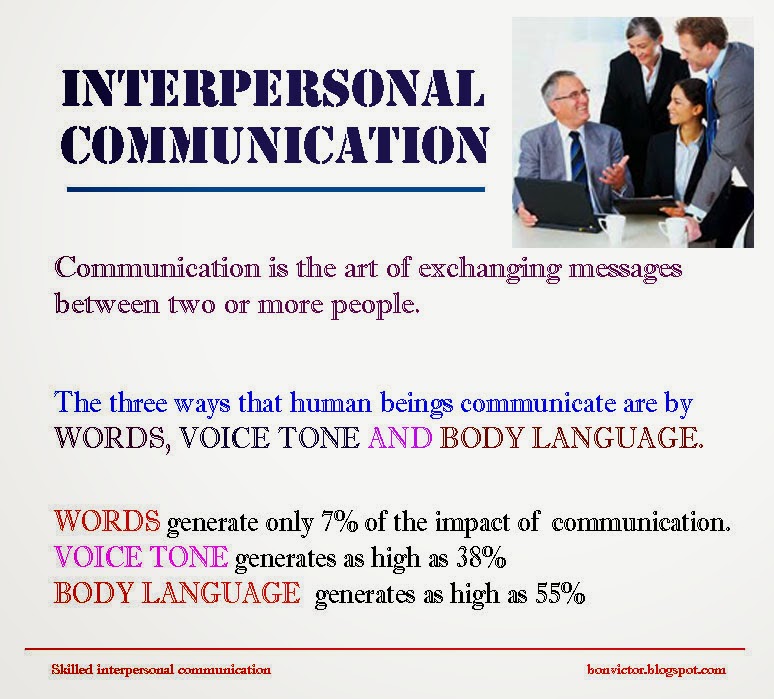
The word communication comes from the Latin communicare, which means ‘to make common’ (Weekley 1967) or ‘to share’. The word interpersonal is derived from the prefix inter, meaning ‘between’ and the word person; Interpersonal communication (IPC) literally occurs between people. Interpersonal communication is an exchange of information between two or more people. Information is conveyed as words, tone of voice and body language. Studies have shown that words account for 7 percent of the information communicated. Vocal tone represents 55 percent and body language 38 percent.

Defining  interpersonal communication

Interpersonal communication (IPC) is defined as the process that we use to communicate our ideas, thoughts and feelings to another person (Wikipedia).
Interpersonal communication is the process by which people exchange information through verbal and non-verbal messages.

Elements of communication

The elements of communication include purpose (why a message is communicated), audience (who is listening to the message), vehicles (the means used to deliver the message), and barriers (outside forces that keep an audience from listening).
Purpose – know what the real purpose of the message (e.g. to persuade or inform);
Audience –know your audience and adapt your message to their particular needs;
Vehicle – choose the best medium (e.g. a report, personal conversation or presentation) for conveying your message;
Barriers –troubleshoot or present possible communication barriers.
All communication has both a purpose and audience. The purpose may be to describe a situation, explain a procedure or persuade someone. An audience is one or more readers or listeners. A communication vehicle is the medium through which something is transmitted, expressed or accomplished. There are many of them e.g. verbal, written and visual. There may be distractions and interruptions. 

Communication model

Effective communication begins with first understanding how the communication process works. The sender-message-channel-receiver model describes the communication process.  In 1949, Claude E. Shannon and Warren Weaver published the transmission model of communication. This model had five components:
  •  An information source, which produces a message;
  • A transmitter, which encodes the message into signals;
  • A channel to which signals are adapted for transmission;
  • A receiver, which decodes the message from the signal and
  • A destination, where the message arrives.

Characteristics of interpersonal communication (Hartley 1999)

  • Communication is from one person to another.
  • Communication is face-to-face. 
  • Both the form and the content of the communication reflect the personal characteristics of the individuals as well as their social roles and relationships.

Forms of interpersonal communication

Communication is more than just verbal. Verbal communication involves all aspects of language: words, style, grammar, content, pitch, volume, tone, pronunciation, pace, timing and the clarity and the use of voice. Non-verbal cues are very important in communication. Non – verbal communication is what we say with our body. It includes physical-facial expressions, eye contact, tone of voice, body posture and motions and positioning within groups. It may also include the way we dress, our silence and other mannerisms. Researchers have estimated that approximately 7 percent meaning is transmitted by words, 38 percent is transmitted by vocal cues and 55 percent is transmitted by body cues.

Principles of interpersonal communication

There are ten principles of interpersonal communication:
1. Interpersonal communication is inescapable-we cannot keep ourselves away from communication.
2. Interpersonal communication is irreversible – it is rightly said that a word uttered once cannot be taken back.
3. Interpersonal communication is contextual – communication does not take place in isolation. They are context specific.
4. Interpersonal communication involves ethical choices – ethics refers to a set of principles or rules for correct conduct. As you respect yourself and your ideas and feelings in ethical communication, you must honour those of others.
5. People construct meanings in interpersonal communication – meanings reside not in words alone, but rather in how we interpret them.
6. Meta-communication affects meanings –meta-communication is communication about communication. Metacommunication may be verbal or nonverbal. It can increase understanding.
7. Interpersonal communication develops and sustains relationships- IPC is the primary way we use communication to develop and sustain relationships.
8. Interpersonal communication is not a panacea – although communication is powerful and important, it is not a cure-all.
9. Interpersonal communication effectiveness can be learned – effectiveness in IPC can be learned through committed study and practice of principles and skills.
10. Interpersonal communication is complicated – no form of communication is simple due to the number of variables involved.

Importance of interpersonal communication

On a fundamental level, interpersonal communication plays an important role in fulfilling several basic human needs like the need to belong, the need for competence and the need for autonomy (Baumeister and Leary 1995). Communication can move communities, influence cultures and change history. It can motivate people to take stand, consider an argument or purchase a product. Competence in oral communication is a prerequisite to student’s academic, personal and professional success in life. Good communication is important in maintaining relationship in family and with friends. Strong communication skills are vital to effective management. Effective communication is very helpful in workplace where we need to interact with different types of people. In general most communication in the workplace is to either convey information or persuade co-workers (or supervisors) about a course of action.

Skilled interpersonal communication

According to Hargie (2011) communication is a form of skilled performance. Skilled interpersonal communication improves individual and group outcomes in life and work. Skills needed for interpersonal communication are self awareness, control over oneself, speaking clearly and pleasantly, good manners and etiquettes, active listening, understanding of non-verbal behaviour and feedback.
GUIDELINES :
Active listening – Listening is the cornerstone for good communication and is often the least developed skill. To listen demands an active effort to search and understand the meaning of what is said. The active listener listens intently with the aim of empathizing with the speaker.
Focus attention – the first requirement for good listening is to pay attention to be completely focused on the speaker. Listen intently and avoid any distractions. Show your are paying attention with eye contact and non-verbal indicators.
Reflect content and feelings – Use your own words to paraphrase the message to check your understanding of what the speaker is saying. Acknowledge the feelings you hear behind the speaker’s message.
Effective questioning – Ask permission to ask questions. It is a good step toward building trust and will allow a more honest, straight forward, free flowing exchange of information. Questioning the speaker helps to obtain more information and to clarify an earlier point.
Assertion – assertiveness is the ability to confront someone in a non-aggressive and non –manipulative manner.
Giving feedback – Feedback is returning output of information based upon input received by another. When communicating, you must learn to be effective both in the way you receive feedback from others and the way you tell others what you think of their ideas.

Uses of interpersonal communication

  • Furnish, gather and understand information.
  • Develop acquaintances and preserve personal relationships.
  • Influence the stances and conduct of others.
  • Make decisions and solve problems.
  • Establish an identity with others.
  • Satisfies your four needs: physical, practical, social and ego.
                        All communication has both a purpose and an audience,

Thursday, February 5, 2015

Professional competencies for superior performance

Competencies are specific personal qualities or behaviours that individuals must have or must acquire to perform effectively at work. Competency consists of knowledge, skills and personal attributes that affect an individual’s ability to perform. Competencies are internal capabilities that people bring to their jobs. A competency is the capability to apply or use a set of related knowledge, skills and abilities required to successfully perform (applied knowledge or the behavioural application of knowledge). According to the Oxford American Dictionary, a person is competent when he or she is properly qualified or skilled. Competence is the quality or state of being functionally adequate or having sufficient knowledge, strength and skill. Every job requires different competencies. Competencies within different contexts may require different bundles of skills, knowledge and attitudes. Competencies are the gauges for job success. Competencies are the behavioural differences between outstanding performers and average performers and thus are the building blocks to the organizational success. Toyota’s organizational core competencies lie in achieving excellence through ‘continuous improvement and waste reduction’. Google has determined that innovation is a critical competency for their success. Pixar, a digital animation movie production studio has created ‘culture of creativity’ is their core competency.

Concept of competency

The word competency is derived from Latin word ‘competere’ which means ‘to be suitable.’ The concept of performance competencies was pioneered by psychologists Robert white and David McClelland. White (1959) identified a human trait that he labelled ‘competence’ which described those personality characteristics associated with superior performance and high motivation. It was McClelland (1973), a professor of psychology at Harvard University who introduced and popularized the term ‘competency.’ Competencies can be grouped as knowledge, skills, self-concepts, motives and traits (Tucker and Cofsky 1994). A competency is more than just knowledge and skills. It involves the ability to meet complex demands by drawing on and mobilizing psychosocial sources (including skills and attitudes) in a particular context. Acquiring a competency is not a one-time event, but rather an ongoing process. Competencies are built over a period of time and are not inborn. It typically takes experiences on the job to build competencies.

Defining competency

1. A competency can be defined as the entirety of knowledge, abilities, skills and attitudes, which are necessary for an individual to work effectively in particular working environment.
2. A person’s ability or capacity to undertake a particular task or job (Sapre 2002).
3. The knowledge, skills and ability required to be successful in the job (Simpson, HRSG).

Competency versus competence

Competency is a person – related concept that refers to the dimensions of behavior lying behind competent performer. Competency is the ability to apply knowledge and skills to produce a required outcome. It is the ability to perform activities within an occupation; to function as expected for employment and the ability to do a job under variety of conditions.  Competence is a work related concept that refers to areas of work at which the person is competent. Competence is the quality or state of being functionally adequate or having sufficient knowledge, strength and skills.
Competencies= competency + competence

Components of competency

Skills: capabilities acquired through practice.
Knowledge: understanding acquired through learning.
Personal attributes: inherent characteristics which brought to the job.
Behavior: the observable demonstration of some competency.
Competence in most professions involves the effective implementation of three main sets of skills:
1.Cognitive skills – refers to the knowledge base of the profession which sets the individual apart from others.
2. Technical skills –refers to the specialized and manipulative techniques essential to the profession.
3. Communication skills –refers to the ability to interact effectively with clients and other professionals.
General competencies will enable individuals, firms and nations to compete successfully in the global economy of the 21st century. The workplace competencies include the abilities to manage resources, use information, work with others, understand systems and use technology. Five competencies most commonly found in international assessments are critical thinking, problem solving, communication, collaboration and flexibility and adaptability.

Value of competencies

Competencies are essential for preparation and success in employment. Competencies may generic to emerging patterns of work and work organizations. Competencies equip individuals to participate effectively in a wide variety of social settings and adult life.  Competencies involve the integration and application of knowledge and skills. Goldsmith and Walt (1999) emphasize the following six  leadership competencies as ‘the desired characteristics of the leader of the future’: thinking globally, appreciating cultural diversity, demonstrating technological savvy, building partnerships and sharing leadership.

Competency categories

Core competencies are those characteristics that apply to every member of the organization regardless of position, function or level of responsibility within the organization The core competency  is based on the value systems, vision and mission of the organization e.g., motivation, trust, problem solving, interpersonal skills and communication. Core competencies need to be identified, acquired and cultivated to form the strategic architecture of a firm. The organization has been compared to a tree with branches and roots. Then core competencies have been compared to roots that provide nourishment.
Functional competencies are characteristics shared by different positions within an organization that belong to a common job group or occupational family or employees performing a common function. The functional competency is built around key business functions like finance, production and marketing.
Job-specific competencies are characteristics that apply only to specific positions within the organization. They built upon the foundation of the organization’s core competencies.  For example a pilot needs a wide range of skills to fly a plane. Job-specific competencies include functional and technical competencies.
Core, functional and job –specific competencies comprise the architecture of a company’s competency model. Organizations may use competency models as a springboard for organizational change. Competency models have also been uses as a guide for employee development.

Dimensions of competency framework

1. Cognitive competence – knowledge (know-that) and understanding (know-why);
2. Functional competences –skills or know-how;
3. Personal competency – behavioural competencies or ‘know how to behave’;
4. Ethical competency – personal and professional values; moral maturity;
5. Meta-competencies – ability to cope with uncertainty; learning and reflection.
Three –dimensional competency framework (KSA=knowledge, skills and abilities)
1. Cognitive competence –knowledge and understanding
2. Functional competence – skills
3. Social competence – behavioural and attitudinal

Mapping competencies

Competency mapping is the process of identifying key competencies (technical, managerial, conceptual knowledge and attitudes and skills etc.) for an organization and the jobs and functions within it.  Competency mapping involves the process by which we determine: the nature  and scope of a specific job role, the skills required, the level of knowledge required and the behavioural capacities required to apply those skills and knowledge in that role. Competency mapping plays a vital role in selecting, recruiting and retaining the right people.  Individual’s level of competency in each skill is measured against a performance standard. When the competency required for a particular position is mapped, an accurate job profile is created.
Competency profiling is a technique used to determine the unique set of competencies associated with effective job performance in a particular organization. Competency profiles summarize the knowledge, skills and abilities required for an open position. The choice of the best candidate is made easier by detailed matching of educational background, experience and training to the requirements of the position.
A competency dictionary lists all of the competencies that are required by an organization to its mandate. It includes the core and all functional and job- specific competencies identified throughout the organization. A competency dictionary also includes information on the proficiency level needed to successfully perform each competency for each position in the organization.  Identifying job-specific competencies prior to recruitment enables one to determine gauges for success.

Competency modeling

Competency modeling is a job analysis method that identifies the worker competencies characteristic of high performance. There are three fundamental components to identifying competencies (Weiss and Kolberg 2003).
1. Select some of the job’s most effective performers.
2. Study what these people do that distinguishes them from their less-effective counterparts.
3. Identify the competencies that account for this difference.

Benefits of competencies

  • Competencies contribute to valued outcomes for societies and individuals;
  • Help individuals meet important demands in a wide variety of contexts;
  • Be important not just for specialists but for all individuals;
  • Identify selection criteria for interviewing potential job candidates;
  • Structure meaningful performance evaluation.

In summary, competencies are specific personal qualities that are casually related to effective and/or superior performance (Boyatzis 1982). Rothwell (2002) explains that core competencies that are required of all workers. This would include knowledge, skills and abilities (commonly referred to as KSAs) as well as soft skills or behaviours (Lucia and Lepsinger 1999). A competency model is a descriptive tool that identifies the competencies needed to operate in a specific role within a(n) job, occupation, organization or industry. Depending on the work and organizational environment, a group of 7 to 9 total competencies are usually required of a particular job (Shippman et al 2000). Competencies are context – specific (Boyatzis 1982). Some competencies are more important or essential than others for a position. Competence bridges the gap between education and job requirements. High performance is often the result of right people, right place and right time.
                         Competence is an individual's know how or skill. 

Saturday, January 31, 2015

Secrets of strategic thinking

A strategy is an individual’s comprehensive approach to a task.In other words strategy is a course of action for achieving an organization’s purpose.To think strategically means to take the long-term view and see the big picture of desired end states and set goals. It is like ‘seeing the forest, not just the trees’ or taking a helicopter ride to a sufficient height to see a big picture (‘helicopter view’ of the firm). Strategic thinking requires the consideration of the past, the present and the future of the firm. Strategic thinking plays a meaningful role in ‘thinking in time.’ Strategic thinking is an ability constantly to view an organization’s operations, issues, and problems in a broad situational and environmental context and with a long time perspective. Thinking strategically requires research, analysis and forethought in order to create a plan for how you will proceed as an organization in the future.  Strategic thinking is a very creative, dynamic and powerful skill that will energize you and your interactions with others. Strategic thinking is a key competency that leaders, managers, supervisors and front-line employees need to develop to enable the organization to identify and take advantage of emerging issues.


Concept of strategy

Strategy is a concept with military roots. Strategy is a term comes from the Greek strategia meaning ‘generalship.’ Strategy is the art of planning and directing overall military operations and movements in a war or battle. Henry Mintzberg in his book, ‘The rise and fall of strategic planning’ points out that people use ‘strategy’ in four different ways:
1. Strategy as plan – strategy is a plan. Strategy is some sort of consciously intended course of action into the future (‘purposeful action’) or a guideline to deal with a situation. It can be general or specific.
2. Strategy as pattern –strategy is a pattern. Strategy is consistency in behaviour over time.
3. Strategy as position – strategy is a position. Strategy becomes a ‘niche’ in economic terms or product-market domain.
4. Strategy as perspective – strategy is a perspective- character of an organization.
Strategy is all of these- it is a plan, position, perspective and pattern (four Ps for strategy). Strategy is a means of establishing the organizational purpose, in terms of its long-term objectives, action programs and resource allocation priorities. A strategy aims to steer the direction of the overall organization. It affects the long-term well-being of the organization. A strategy is future –oriented and marked by uncertainty and risk.

Strategy versus tactics

A strategy is the approach you take to achieve a goal. Strategy is being clear about where you want to go. Strategy has been characterized as “...the pattern of decisions in a company that determines and reveals it objectives, purposes or goals...” Strategy is undertaken before the battle. Tactics are implemented during the battle. A strategy is a larger plan that can comprise several tactics, which are smaller, focused, less impactful plans that are part of the overall plan. Strategy is a thinking process required to plan a change, course of action or organization. A tactic is a tool used in pursuing an objective associated with a strategy. Tactics are the specific actions that are undertaken in implementing the strategy. These actions comprise what is to be done, in what order, using which tools and personnel. Every tactic must suit the strategy. Tactics are the actions that lead to execution of the strategy. Tactics are made up of a few elements: an action, a purpose, a schedule and a measurable result.

Definition and explanation

Strategic thinking is defined as the individual’s capacity for thinking conceptually, imaginatively, systematically and opportunistically with regard to the attainment of success in the future.
Strategic thinking is not similar to critical thinking. Critical thinking can be useful part of strategic thinking but critical thinkers are less likely to be imaginative and opportunistic. Strategic thinking is also not similar to creative thinking. Creative thinking is imaginative and playful. Moreover creative thinking attends to a lesser degree to concepts, systems and opportunities.  Strategic thinking is identifying, imagining and understanding possible and plausible future operating environments for your organization.  Strategic thinking is goal – directed, structured and focused on the future in a precise way. It is analytical and ambitious. It concerns power and trends as well as uncertainty.

Strategic planning

Strategic planning is the channelling of business insights into an action plan to achieve goals and objectives.  A strategic plan is a top-level overview of an organization, its performance, its mission and its goals. A strategic plan is like a game plan for the team to follow. It is a step-by-step operating instruction of an organization.
Create vision àdefine objectivesàdefine strategiesà implementàcontrol.

Strategic management

Strategic management is the continuous process of creating, implementing and evaluating decisions that enable an organization to achieve its objectives.
Strategic management à strategic planning +implementation+control.

Elements of strategic thinking

Conceive an ideal future –strategic thinking begins with a clear image of the desired long-range future for the organization. Based on the vision, decisions and actions are formulated.
Focus on core values –based on the core values of the organization – strategic decisions and actions are clearly defined and accepted by the people at all levels of the organization.
Always look for opportunities and threats – strategic thinking mind set depends on a keen awareness of the environment. Strategic thinkers always discover opportunities and detect potential threats in advance.
Search for patterns and relationships –strategic thinkers recognize the patterns between events and circumstances.
Recognize connections - strategic thinkers are deeply aware of interrelationships between actions and events within a system.

Value of strategic thinking

1. Strategic thinking keeps the organization at the leading edge of change.
2. Strategic thinking optimizes the ability to shape and leverage change to organization’s advantage.
3. Strategic thinking eliminates complacency.
4. Strategic thinking creates a sense of unity.
5. Strategic thinking provides proactive leadership and the leaders think systematically with a system’s approach.
6. Strategic thinking creates a life-long learning atmosphere.
7. Strategic thinking provides an effective system to solve major problems.
8. Strategic thinking improves the understanding of the business environment.

Strategic thinking framework (ref: net source)

Strategic thinking can occur in two phases each of which consists of specific steps.
Phase I –setting the stage –consists of two stages
1.  Seeing the big picture – understanding the broader business environment in which you operate.
2. Articulating strategic objectives –determining what you hope to achieve by thinking strategically.
Phase II –applying your skills – consists of 5 additional steps.
1.  Identifying relationships, patterns and trends- detecting patterns across seemingly unrelated events and categorizing related information.
2. Getting creative – generating alternatives, visualizing new possibilities, challenging your assumptions and opening yourself to new information.
3. Analysing information – sorting out and prioritizing the most important information, while making a decision, implementing a project, handling a conflict etc.
4. Prioritizing your actions – staying focused on your objectives while handling multiple demands and competing priorities.
5. Making trade –offs –recognizing the potential advantages and disadvantages of an idea or course of action.

Characteristics of strategic thinker

1. Curiosity – being genuinely interested in what is going on in your unit, company and industry.
2. Flexibility –trying new approaches and ideas.
3. Focus on the future – remaining alert for opportunities that may prove valuable in the future.
4. Openness – welcoming new ideas from peers, customers, suppliers and business partners.
5. Positive outlook – viewing challenges as opportunities and believing that success is possible.
6. Self-awareness – continually working to broaden your knowledge and experience.

Strategic analysis tools

Strategic analysis is the process of conducting research on the business environment within which an organization operates and on the organization itself, in order to formulate strategy.  The strategic analysis tools include PEST, five forces, value chain and SWOT.
PEST analysis – It is a useful tool for understanding the political, economic, socio-cultural and technological environment that an organization operates in it. It can be used for evaluating market growth or decline and as such the position, potential and direction for a business.
Porter’s five forces model – A tool that can be used to evaluate the five forces of competition position analysis: buyer power, supplier power, intensity of rivalry, threat of substitutes and threat of new entrants. This simple framework assesses and evaluates the competitive strength and position of a business organization.
Value chain analysis – A tool based on the principle that organizations exist to create value for their customers. The value chain analysis reveals about your internal strengths and weaknesses. This method divides your firm into its value –producing activities, with aim of evaluating what makes the firm strong and what makes it weak.
SWOT analysis – A SWOT analysis is a simple tool that helps in understanding strengths, weaknesses, opportunities and threats involved in a project or business activity. It starts by defining the objective of the project or business activity and identifies the internal and external factors that important to achieving that objective. Strengths and weaknesses are usually internal to the organization, while opportunities and threats are usually external.

Benefits of strategic thinking

Strategic thinking offers guidance on the actions to achieve the vision and mission of the organization. Strategic thinking raises awareness about the threats and opportunities involved in a business activity. Strategic thinking aligns the organization around a common direction and set of priorities; improves teamwork and employee’s commitment. Strategic thinking improves the quality of decision making and speed of implementation. Strategic thinking improves organizational efficiency and effectiveness.  Strategic thinking fosters a culture that supports new ideas and creativity for the benefit of the organization.
                         Strategy is undertaken before the battle
                         Tactics are implemented during battle.
                              Strategy + Execution= Success.

Thursday, January 29, 2015

The qualities of successful teams

A team is a group of individuals committed to a common goal.Teamwork is a complex process: a group of people pooling their skills, talents and knowledge. In good teams, people with complementary skills work together, each playing to their strengths and each recognizing the strengths of the other team members.The criteria for effective team performance are a deep commitment to a common purpose and the sharing of common goals.One of the key elements of a winning team is a feeling of inter-dependency-one for all and all for one (Stuart –Kotze 2008). Teamwork is the glue which promotes collaboration, commitment, motivation, dependability and accountability among team members. The purpose of a team is to help the organization as a whole to achieve its objectives. Effective teamwork increases problem-solving, decision quality, creativity and innovation. . Vince Lombardi said, “Build for your team, a feeling of oneness, of dependence upon one another, and of strength to be derived from unity”.

Defining teamwork

A team is a group of individuals working together to achieve a common goal or purpose.
Teamwork is the process of working collaboratively with a group of people in order to achieve a goal.
A team is small group of people with complementary skills who are committed to a common purpose, performance goals and approach for which they hold themselves mutually accountable.

7 - essential skills for teamwork

Listening –team members listen to each other’s ideas.
Questioning –team members question each other.
Persuading – team members use persuasion.
Respecting – team members respect the opinion of others.
Helping – team members help each other.
Sharing – team members share ideas and report their findings to each other.
Participating – team members contribute to the project.

Team building stages (Bruce Tuckman model, 1965)

Team building is a process that takes place over time. The start of the process is where there is a group of people, two or more and a leader. The end of the process is where there is a high performing team. The development of a group of people into a team takes time, commitment and energy. A successful team exhibits synergy (the sum is greater than the parts) between the individual members of the team. Henry Ford said, “Coming together is a beginning. Keeping together is progress. Working together is success.”
Forming – stage where the team is first formed. Team members start to work together.
Storming – stage where impatience with progress occurs. Team members challenge their shared purpose.
Norming – team members star to resolve their differences, appreciate colleague’s strength and respect the leader.
Performing – stage where the mature team understands its strengths and weaknesses. Members are satisfied with progress.

Teamwork principles

Strength in numbers – teams function best when the strengths of individuals are combined together.
Integrity – team members exhibit shared perception so that their strengths combine to enhance what they do.
Alignment – the strengths of individuals and the support of colleagues are directed towards meaningful goals in the organization.
Results – the team focuses on delivering results it has a clear performance focus.

Qualities of effective team player

Genuine commitment –An outstanding team player cares about his/her work, the team and the team’s work. The team player exhibits care and commitment to the team’s work.
Open communication – Great team player communicates his/her ideas honestly and clearly and respects the views and opinions of others in the team.
Always reliable – every team needs reliable team members. Reliable team member gets his work done and does his fair share to work hard and meets commitments.
Active listening – good listeners are essential for teams to function effectively. Effective communicators also listen carefully.
Active participation – good team players are active participants. They come prepared for team meetings and listen and speak up in discussions.
Information sharing – Outstanding team player willingly shares information, knowledge and experience.
Cooperation – cooperation is the act of working with others and acting together to accomplish a job. They respond to requests for assistance and take the initiative to offer help.
Exhibits flexibility – Inflexibility is one of the worst human failings. A flexible team member can consider different points of views and compromise when needed.
Problem solver – an exemplary team player is willing to deal with all kinds of problems in a solution – oriented manner.
Support and respect – an outstanding team member treats fellow team members with courtesy and consideration. They show understanding and the appropriate support to other team members.

The qualities of an effective team leader

The team leader is typically a member of the team who provides guidance and support and has ultimate responsibility for the outcomes of the team (Bachiochi et al 2000). According to Zengu et al (1994), team leaders must (1) build trust and inspire teamwork (2) facilitate and support team decisions and (3) expand team capabilities. Team leaders should have significant responsibility, trust, emotional stability and flexibility.

Kinds of teams

Global teams – cross-border teams made up of members from different nationalities.
Virtual teams – consist of geographically dispersed members linked via technology.
Cross functional teams – team members from the same hierarchical level but from different work areas, come together to accomplish a task.
Creative team – a type of team created for the purpose of developing innovative solutions.
Tactical team – a team created for the purpose of executing a well defined plan.
Hierarchical teams – are the traditional type of teams and are most common.
Multidisciplinary teams –are groups drawn from different parts of the organization.

Characteristics of team processes

Team coordination – coordination refers to orderly interpersonal actions required to perform complex tasks. Effective teams harness the variety and minimize the differences of members to ensure that expert skills and knowledge are well utilized.
Team communication – Communication refers to an observable interchange of information and subtle interactions of power, attitudes and values. Effective teams show two-way communication processes with clearly defined responsibilities and appropriate delegation.
Team cohesion – Team cohesion acknowledges member’s personal attraction to the team and the task. Members cooperate interdependently around the team’s task in order to meet team goal.
Team decision making – team decision making is the process through which a team chooses an alternative. Team performance depends largely on the choices made by the team. These choices, in turn, depend on the processes through which teams decide. Therefore high’ performance teams require processes through which teams make high quality decisions.
Team conflict management – team conflict can source both creativity and destruction. For teams to value creative contributions and promote effective problem – solving, diversity needs careful management. Destructive team conflict often has an interpersonal basis in work role or organizational factors.
Social relationships – good social relationships maintain effective teams. Personally team members who are empathetic and supportive offer practical assistance, share information and collaboratively solve problems.
Performance feedback – Individuals, teams and the organization all require accurate and timely feedback about the team’s performance in order to maintain effectiveness.

Characteristics of  successful teams

1. Effective teams are committed to a common purpose and goal. Team members must collectively understand and commit to their team’s purpose.
2. The atmosphere in an effective team tends to be informal, comfortable and relaxed. They are provided with clear expectations and adequate resources to accomplish its goals.
3. The team members must be able to communicate effectively with each other.
4. The team members are free in expressing their feelings as well as their ideas.
5. The members of the team are trustworthy and they rely on each other understanding their own strengths and weaknesses.
6. Effective teams set clear and demanding performance goals. The team defines and achieves a continuous series of small wins along the way to longer goals.
7. The team members appreciate the diversity of knowledge that the other team members offer.
8. The members of the team are creative and unafraid to share opinions, ideas and suggestions.
9. Effective team members avoid conflicts when challenges occur and instead focus on overcoming those challenges.

Enemies of teamwork

Effective teamwork may be undermined by a variety of problems, for example disorganization, poor communication, gossip, misunderstandings, lack of shared purpose or inadequate procedures for problem-solving.

Benefits of teamwork

Teamwork can lead to better decisions, products and services. Teamwork accelerates growth and heightens productivity and profit margins.  Teamwork can allow healthy competition among team members to outperform each other. Teamwork can be a source of education and inspiration. Teamwork allows an easier flow of information and solves problems easily.  Teamwork develops trust and reduces stress. Teamwork helps development, fine tune and executes a project in the most innovative way possible. Teamwork plays a very important role in organization as well as our personal lives.

 Family as a successful team

A family is like a team –Make your family a ‘team’ which will bring wonderful benefits to your young children. It can teach them selflessness, cooperation and develop a strong family bond.
                                        Teamwork is a goal-driven process.
                                                    Unity is strength.